What does dispart mean?
Dispart is a rare English verb meaning to divide or separate something into parts, as when a wall or river splits one tract of land from another. It derives from the Latin dispertire, formed from dis- ('apart') and partire ('to divide'), sharing its root with familiar words such as part and partition. Although the general sense of 'to divide' is now chiefly literary, the word has an unexpected second life in the history of artillery: gunners once used 'dispart' as a noun for the slight difference in a cannon's wall thickness between breech and muzzle, and as a verb for sighting the piece to compensate for it. Today you are most likely to meet dispart in older prose, poetry, or technical treatises on gunnery. Its precision and Latinate dignity make it a striking choice when a writer wants a weightier alternative to 'divide' or 'split,' though modern readers may need the context to grasp its sense immediately.
To divide or separate into parts; to split apart.
"A narrow stream disparted the two estates."
Chiefly literary or archaic in modern usage.
In historical gunnery, the difference between the thickness of metal at the breech and at the muzzle of a cannon.
"The gunner measured the dispart before laying the piece."
Restricted to historical military texts.
Applies only to the rare military noun; the verb does not take a plural form.
"Early artillery manuals listed the disparts of various guns."
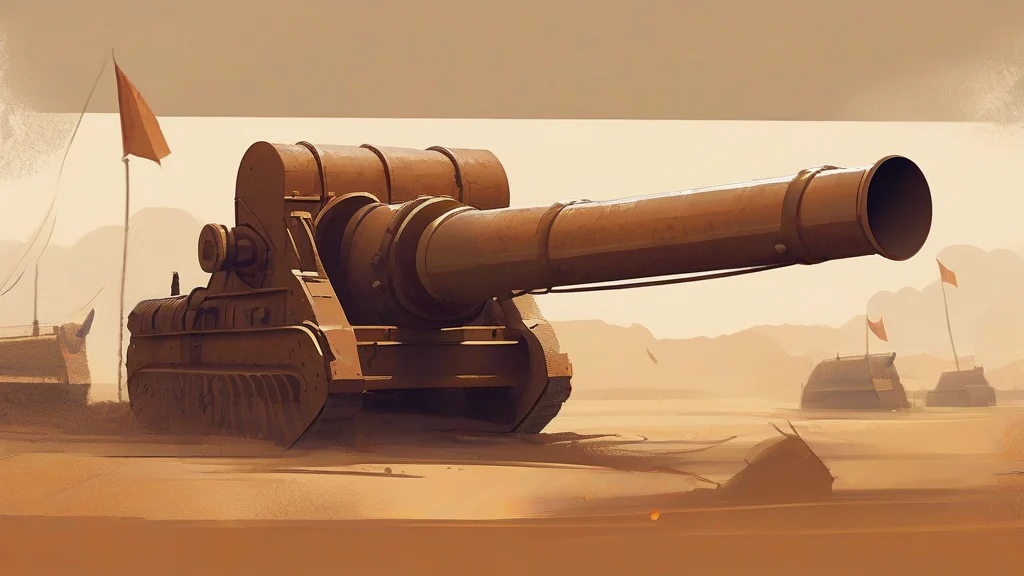
Before cannons could fire straight, gunners had to measure the 'dispart'—the tiny difference between a barrel's breech and muzzle—to aim true.
Reviewed by Deb Chak, Editor. AI-assisted content curated by RJS Tech Solutions LLP.
Etymology of dispart
Dispart comes from the Latin verb dispertire, meaning 'to divide,' formed from dis- ('apart') and partire ('to share or divide'), which itself derives from pars, partis ('a part'). The word entered English around the early 17th century, first in the general sense of dividing or separating, and soon acquired a specialized use in gunnery referring to the difference in a cannon's bore or metal thickness between breech and muzzle. Its cognates include the everyday words part, partition, and depart, all descended from the same Latin root pars.
Related word forms
How dispart is actually used
Rare and largely literary today; the divisional sense appears mostly in older or poetic prose. The military sense survives only in historical texts on gunnery. Not to be confused with the common verb 'depart.'
Easily confused with dispart
Depart means to leave or go away, while dispart means to divide something into parts.