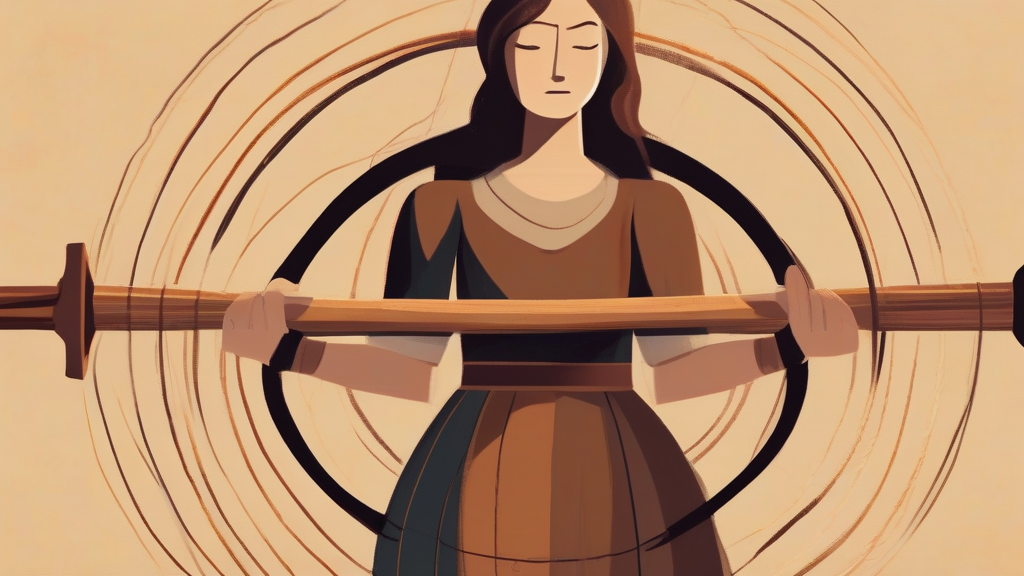
What does distaff mean?
A distaff is a short staff, typically with a cleft or forked top, around which wool or flax was wound before being drawn out and spun into thread. In pre-industrial households the distaff was the constant companion of spinners, and because spinning was overwhelmingly women's labor, the word gradually came to stand for women and their work as a group — a sense preserved today chiefly in phrases like 'the distaff side,' which denotes the female branch of a family or, in older usage, women collectively. The literal object has all but vanished from daily life, surviving mostly in historical writing, museums, and literary description, while the figurative sense lives on most naturally in genealogical contexts such as tracing a family through its distaff line. The word carries a slightly old-fashioned, literary flavor, so it suits formal or historical register rather than everyday conversation, but it remains a vivid and precise term for anyone writing about textile history or family lineage.
A staff with a cleft end on which wool or flax is wound for spinning.
"She loaded the distaff with freshly carded wool and began to spin."
Primarily historical or literary in modern usage.
Women or women's work regarded collectively; the female side of a family.
"The estate passed down through the distaff for three generations."
Usually encountered in the phrases 'the distaff side' or 'distaff line.'
Standard plural; occasionally rendered as 'distaves' in archaic or deliberately antiquarian prose.
"The museum's collection includes several medieval distaffs carved from ash wood."
"Distaff" comes from an Old English word literally meaning "to dip down" — and for centuries, the humble stick that held spinning fiber became the very emblem of womanhood itself.
Reviewed by Deb Chak, Editor. AI-assisted content curated by RJS Tech Solutions LLP.
Etymology of distaff
Distaff derives from Old English 'dīcestæf,' a compound of 'dīce' (a bunch of flax, related to the verb 'dīcan,' to dip or plunge) and 'stæf' (staff). The word is thus Germanic in origin, with cognates in other Germanic languages reflecting the same compound structure. By the Middle Ages it had already acquired its figurative association with women's work, since spinning from the distaff was characteristically female labor, a link reinforced by expressions in medieval European languages pairing the implement with the feminine sphere.
How distaff is actually used
The literal spinning sense is now largely historical or literary; modern usage survives mainly in genealogy ('distaff line,' meaning descent through female ancestors) and in the fixed phrase 'the distaff side.' The word can function adjectivally (e.g. 'a distaff relative'), though some style guides prefer clearer phrasing.
Easily confused with distaff
'Staph' is short for staphylococcus bacteria, whereas 'distaff' is a spinning implement or a term for the female side of a family.