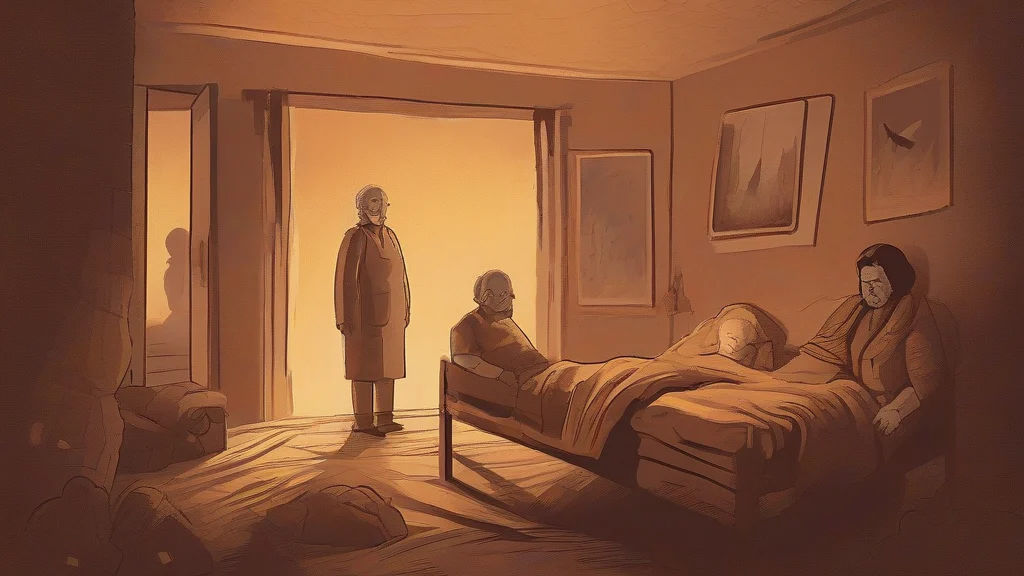
What does distemperature mean?
"Distemperature" is an archaic noun denoting a state of disorder or imbalance, most commonly a disturbance of the body's natural condition. In the medicine of Shakespeare's era, illness and even strong emotion were explained as a distemperature of the four humors — blood, phlegm, yellow bile, and black bile — whose proper balance was thought to determine both physical health and personality. By extension, the word could describe any troubled or disordered state, whether of a person's mind, a household, or a nation. Today "distemperature" survives only in literary, historical, or deliberately elevated prose, lending an antique flavor to descriptions of turmoil. It derives from Latin roots shared with "temperament," "temperance," and "intemperate." Readers encountering it should understand it essentially as an old-fashioned synonym for disorder, malaise, or disturbed equilibrium rather than anything to do with heat.
nounA state of disorder or imbalance, especially a disturbance of the body's health or temperament; in older usage, an upset of the four bodily humors causing illness or emotional agitation.
- A disorder or imbalance of the body's humors, producing illness or altered temperament (archaic, medical).
- Any disturbance, disorder, or agitated state, literal or figurative (literary).
"The physician diagnosed a distemperature of the humors and prescribed rest and a plainer diet."
"Shakespeare's characters often attribute sudden passion to some distemperature of the body."
"The kingdom's political distemperature was evident in every quarreling faction."
Rarely pluralized; the word usually appears in the singular.
"The treatise catalogued various distemperatures of the humors."
Before thermometers told us we had a fever, doctors blamed your 'distemperature' — an actual upset of the four bodily fluids that governed both your mood and your health.
Reviewed by Deb Chak, Editor. AI-assisted content curated by RJS Tech Solutions LLP.
Etymology of distemperature
"Distemperature" comes from Latin "temperare" (to mix properly, temper) via Old French and Middle English, formed by prefixing the negative "dis-" to "temperature." It entered English in the sixteenth century, when learned medical vocabulary drew heavily on Latin. Its closest relatives — "temperament," "temperate," "temperance," and "intemperate" — all descend from the same Latin root concerning proper mixture or moderation.
How distemperature is actually used
Archaic and literary; today it appears almost exclusively in historical, medical-history, or deliberately ornate writing. It carries a formal, somewhat antiquated tone.
Easily confused with distemperature
"Temperature" denotes a degree of heat or coldness, while "distemperature" refers to a disorder or disturbed balance, especially of the body or mind.