What does diya mean?
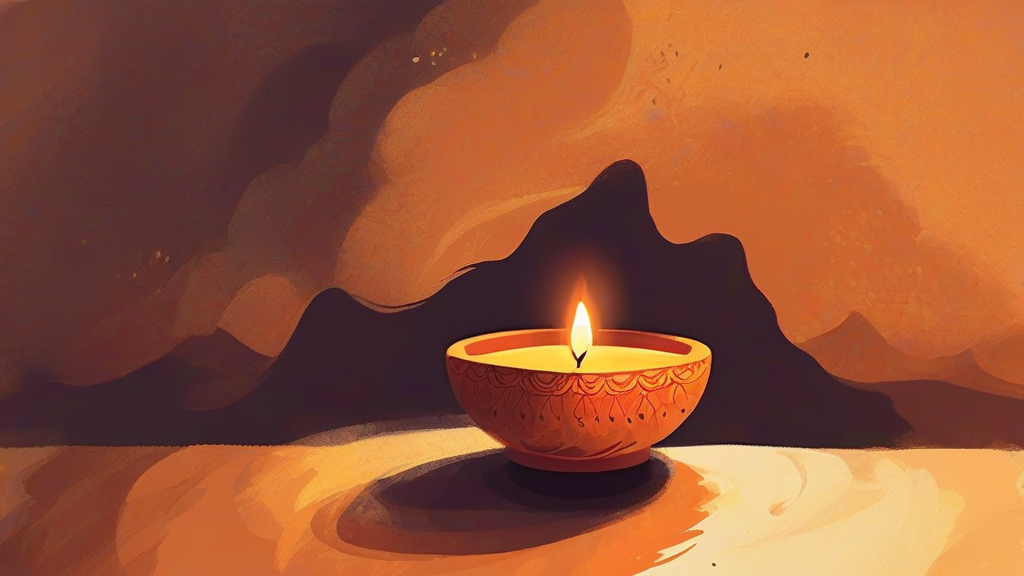
A diya is a small, usually hand-moulded clay lamp that burns oil—traditionally ghee or mustard oil—with a cotton wick. Deeply rooted in South Asian tradition, it is central to Hindu, Sikh, Jain, and Buddhist ritual practice, most famously during Diwali, when homes, temples, and streets are illuminated with rows of glowing diyas to symbolise the victory of light over darkness and good over evil. Beyond its religious role, the diya carries strong connotations of warmth, welcome, and hope, and it often appears in weddings, housewarmings, and other auspicious occasions. In modern usage, decorative versions may be made of brass, ceramic, or coloured glass, and floating diyas are popular at celebrations. Borrowed from Hindi into English, 'diya' is now widely recognised in international coverage of Indian festivals, making it a useful word for anyone describing South Asian cultural life.
nounA small earthenware oil lamp with a cotton wick, traditionally used in India and elsewhere in South Asia for religious ceremonies, especially during Diwali.
- A small earthen oil lamp with a wick, used especially in Hindu worship and festivals such as Diwali.
"She lit a diya at the doorstep to welcome Lakshmi on the night of Diwali."
"Every evening of the festival, a tiny diya flickered on each windowsill along the street."
"The children floated paper boats carrying small diyas down the river."
Standard English plural adds '-s'; in some South Asian contexts 'diya' may be treated as invariant, but 'diyas' is preferred in general English.
"She placed a hundred small diyas around the courtyard before the ceremony began."
The humble clay diya has been glowing across South Asia for centuries — millions are lit in a single night during Diwali.
Reviewed by Deb Chak, Editor. AI-assisted content curated by RJS Tech Solutions LLP.
Etymology of diya
The word 'diya' comes from Hindi and Urdu दीया/دییا (dīyā), meaning a small oil lamp, which itself derives from Sanskrit 'dīpaka' and related forms built on the root 'dīp-', meaning to shine or burn. It shares this ancestry with words such as 'deepam' (the Sanskrit term still used in South India) and 'Deepavali', the older name for Diwali, literally the 'row of lamps'. The word entered English through contact with South Asia, becoming common in British and global English as interest in Indian festivals grew.
How diya is actually used
The word is borrowed directly from Hindi/Urdu and is most natural in contexts relating to South Asian culture, religion, or festivals; in general English writing, 'clay lamp' or 'oil lamp' may be used with 'diya' as clarification. The plural is usually 'diyas', though 'diya' can function as a plural-like collective in some South Asian usage.
Easily confused with diya
'Dia' is not the lamp; 'diya' is the South Asian oil lamp, while 'dia' is typically a name or an abbreviation.