What does dobsonfly mean?
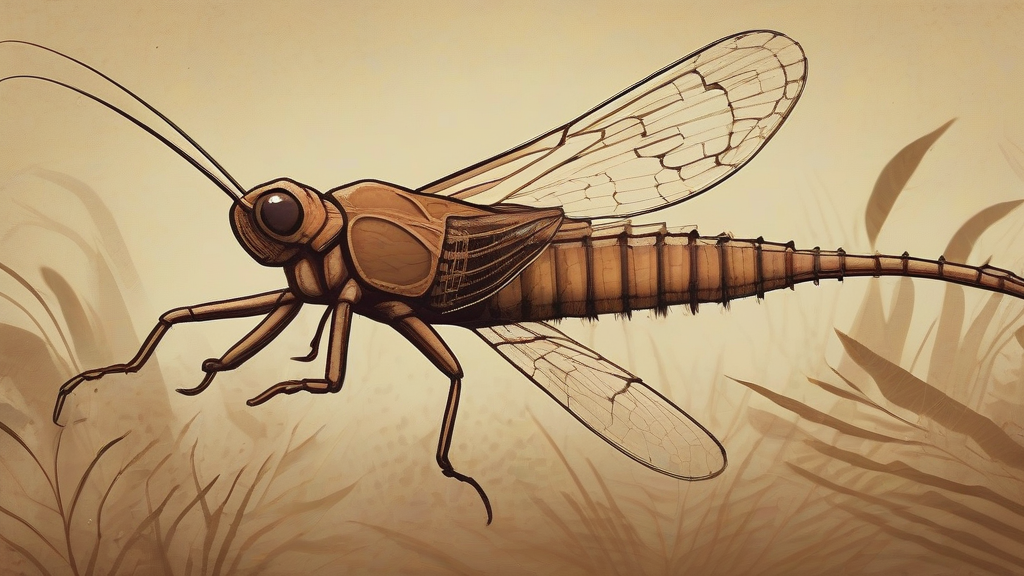
The dobsonfly is a large insect belonging to the family Corydalidae, best known from the eastern dobsonfly (Corydalus cornutus) of North America. Adults have long, dark, membranous wings that fold rooflike over the body, and they are famous for the male's spectacularly elongated, tusk-like mandibles, which can exceed half the length of the insect itself. Despite their fearsome appearance, these oversized jaws are poor weapons and are used chiefly to grasp the female during mating; the female's shorter mandibles deliver a much more effective pinch. Dobsonflies spend most of their life cycle in water as larvae called hellgrammites, which live under stones in fast-flowing streams and are prized by anglers as bait for bass. Adults live only briefly near water, are typically nocturnal, and are strongly attracted to lights.
nounA large aquatic insect of the family Corydalidae (especially genus Corydalus), having long membranous wings and, in the males of some species, greatly enlarged mandibles. Its aquatic larva, known as a hellgrammite, is used as fishing bait.
- Any large winged insect of the family Corydalidae, especially the North American eastern dobsonfly (Corydalus cornutus).
"The fisherman turned over the streamside stones in search of dobsonfly larvae for bait."
"A male dobsonfly rested on the porch screen, its tusk-like mandibles spanning more than an inch."
"Anglers prize the dobsonfly's larva, the hellgrammite, as one of the best live baits for smallmouth bass."
Regular plural: words ending in consonant + y change y to ies.
"Dobsonflies are often found near fast-moving streams on summer nights."
The male dobsonfly's enormous scimitar-like jaws look terrifying — but they're so long and curved they barely work as weapons; it's the female's short, sharp pincers that actually bite.
Reviewed by Deb Chak, Editor. AI-assisted content curated by RJS Tech Solutions LLP.
Etymology of dobsonfly
The word combines 'dobson', a name of uncertain origin applied to the insect's larva in American English, with 'fly'. The term emerged in nineteenth-century American usage, and the element 'dobson' itself has no securely established etymology, though it is often assumed to derive from a personal name. The adult insect was formerly also known regionally by other names, including 'devil fish' and 'toe biter' for its larva.
Related word forms
How dobsonfly is actually used
The word is most common in North American English, where the insect occurs. It is a neutral, scientific-cum-colloquial term; entomologists may specify species such as the eastern dobsonfly (Corydalus cornutus). The larva is almost always called by its separate name, hellgrammite.
Easily confused with dobsonfly
A dragonfly is a slender predatory insect with two pairs of transparent wings held out flat at rest, whereas a dobsonfly is a larger, softer-bodied insect with prominent mandibles and wings folded rooflike over its body.