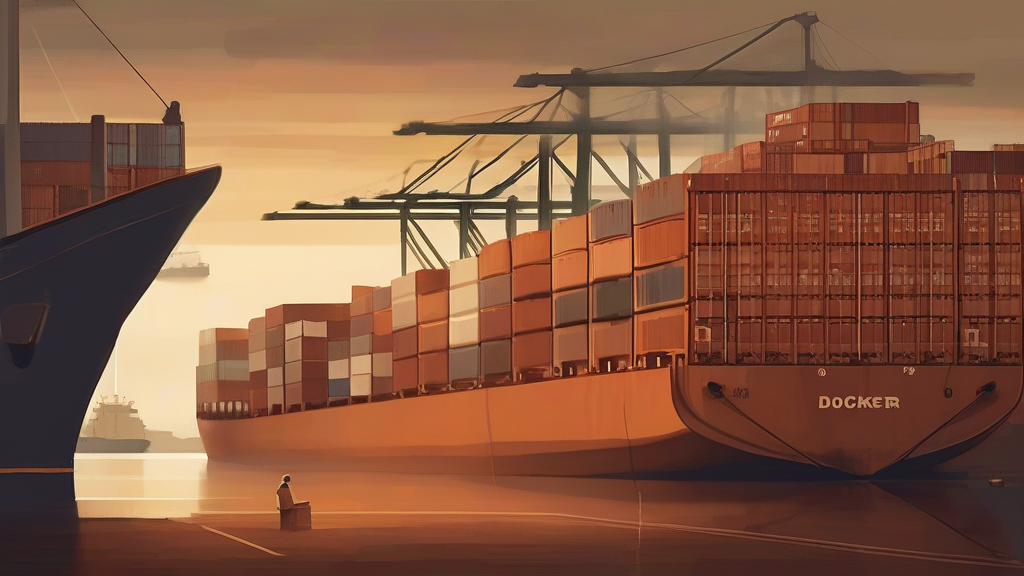
What does docker mean?
A docker is a manual laborer who works at a port or dock, loading and unloading cargo from ships. The occupation has historically been physically demanding, casual, and closely tied to the rhythms of maritime trade. Dockers have played a prominent role in labor history, with strikes and union organizing among port workers shaping industrial relations in many countries. The word is chiefly British; in North America, equivalent workers are more often called longshoremen or dockworkers, while Australian English uses 'wharfie'. Beyond its literal meaning, the word occasionally appears in compounds such as 'docker's hook', a tool used for handling cargo. In modern usage the term may also evoke the heritage of great port cities like Liverpool or London, where docker communities were once central to local life. With the rise of containerization, which dramatically reduced the need for manual labor, the traditional docker's role has declined sharply worldwide.
nounA docker is a person who works at a docks or wharf, loading and unloading cargo from ships.
- A person employed to load and unload cargo from ships at a dock or port.
- (Less common) A type of flat cap worn by dockworkers in Britain.
"The docker heaved the crate onto the waiting truck with practiced ease."
"Thousands of dockers went on strike over proposed automation of the port."
"He wore an old docker's cap pulled low against the sea wind."
Standard regular plural; used both for individual workers and collectively for port labor forces.
"Hundreds of dockers gathered at the gates before dawn."
Reviewed by Deb Chak, Editor. AI-assisted content curated by RJS Tech Solutions LLP.
Etymology of docker
The word docker derives simply from 'dock', meaning a place where ships are loaded and repaired, plus the agentive suffix '-er', denoting one who works there. The noun 'dock' itself entered Middle English in the late medieval period, likely from a Dutch or Low German source such as 'dokke'. Docker as a term for a port laborer became established during the nineteenth century, when large-scale commercial docks developed in Britain. Its cognates are essentially the family of words built on 'dock' itself — dockyard, dockside, and related terms — rather than words in other languages.
How docker is actually used
The term is more common in British English; American English typically uses 'longshoreman' or 'dockworker'. The word can carry working-class connotations and is often associated with port cities and labor movements.
Easily confused with docker
A doctor is a medical practitioner, while a docker is a manual laborer who loads and unloads ships.
Capitalized 'Docker' refers to the software containerization platform; lowercase 'docker' refers to a dock worker.