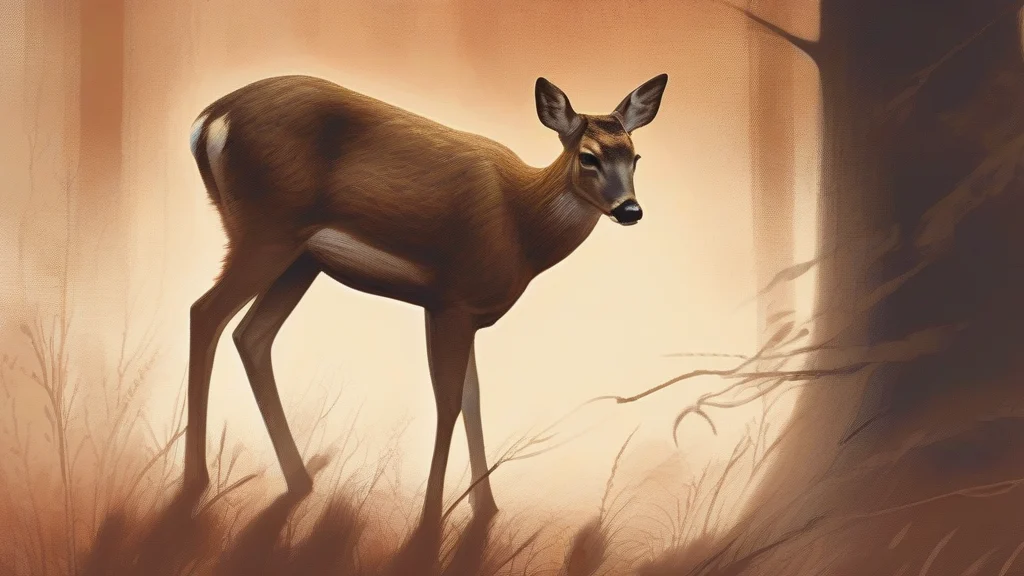
What does doe mean?
A doe is an adult female deer, a term used most precisely for species such as the roe deer, fallow deer, and white-tailed deer. In everyday speech it contrasts with 'buck' or 'stag', the male counterpart, and with 'fawn', its young. The word carries quiet, pastoral connotations, evoking woodland scenes and gentleness, which is why it survives in figurative expressions such as 'doe-eyed', describing large, innocent-looking eyes. Usage varies by region and species: in traditional British hunting terminology the female red deer is called a 'hind', reserving 'doe' for other species, while American English applies 'doe' freely to females of nearly any deer species, including antelope-like animals colloquially. Beyond wildlife writing and hunting, the word appears frequently in literature and children's stories, where it stands as a simple, evocative emblem of the natural world.
nounAn adult female deer, especially of the red deer, fallow deer, roe deer, or similar species.
- An adult female deer, particularly of species such as the roe deer, fallow deer, or white-tailed deer.
"A doe stepped quietly out of the treeline at dusk."
"The hunter waited patiently as the doe crossed the clearing."
"She watched a doe with two fawns grazing at the edge of the garden."
The plural is spelled 'does' but pronounced differently from the auxiliary verb 'does'; context and pronunciation distinguish them.
"The meadow was dotted with does grazing in the early morning light."
In most British deer species, only the female fallow and roe deer are called does — a red deer female is properly a hind.
Reviewed by Deb Chak, Editor. AI-assisted content curated by RJS Tech Solutions LLP.
Etymology of doe
Doe comes from the Old English word 'dā', meaning a female deer, and belongs to the ancient Germanic vocabulary of hunting and wildlife. It has been in continuous use since before the Norman Conquest, making it one of the older animal names in English. Its exact cognates in other Germanic languages are not clearly established, so its wider family history remains somewhat obscure despite the word's long attestation.
How doe is actually used
Strictly applied to certain species: the female red deer is traditionally called a 'hind' rather than a doe, though in general American usage 'doe' is applied broadly to any female deer. The term carries gentle, pastoral connotations and appears in the fixed phrase 'doe-eyed', describing wide, innocent-looking eyes.
Easily confused with doe
A doe is a female deer, while dough is a soft mixture of flour and liquid used in baking.
Doh is the first note of the musical scale (also an expression of dismay), whereas a doe is a female deer.