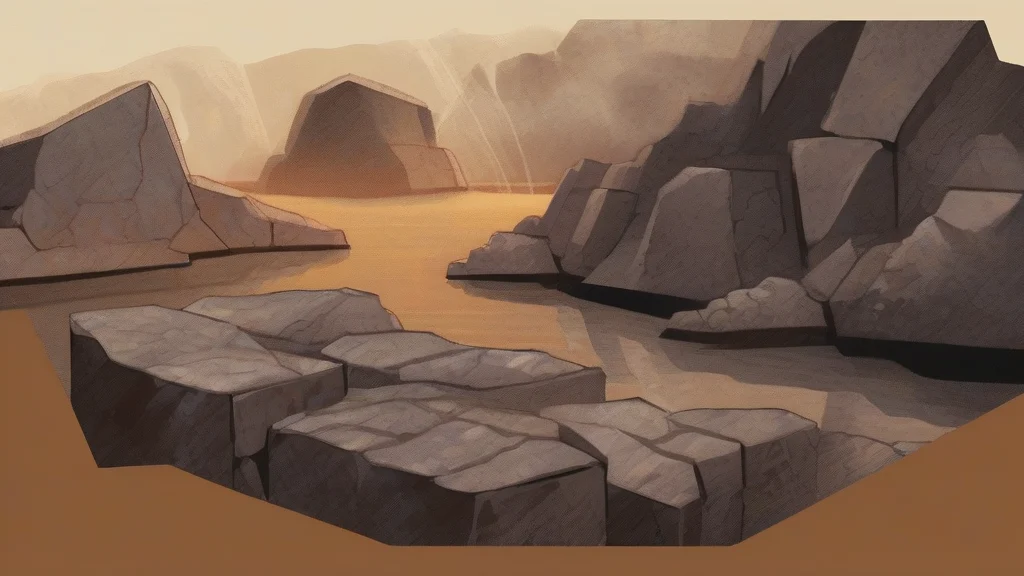
What does dolerite mean?
Dolerite is a dark-coloured igneous rock with a grain size intermediate between fine-grained basalt and coarse-grained gabbro, made up mainly of plagioclase feldspar and pyroxene. It typically forms when magma cools relatively slowly within the Earth's crust, filling fractures as dykes or spreading between sedimentary layers as sills, rather than erupting at the surface like lava. The word is standard in British and Commonwealth geology; North American scientists usually call the same material diabase. Dolerite is hard and durable, which has made it valued since prehistoric times — it was quarried for stone axes and later for road metal, kerbstones, and building work. Familiar landmarks built on or from dolerite include the Whin Sill in northern England, which carries Hadrian's Wall along its crags. The name derives from the Greek doleros, meaning deceitful, a wry acknowledgment by early mineralogists of how readily this rock defied their attempts to classify it.
nounA dark, medium- to coarse-grained igneous rock of composition similar to basalt, typically occurring as dykes and sills. In North American usage the same rock is usually called diabase.
- A dark, medium-grained basic igneous rock chemically equivalent to basalt, occurring chiefly in dykes and sills; called diabase in North America.
"The ancient walls were built from blocks of local dolerite quarried from the ridge above the valley."
"The Whin Sill, a vast sheet of dolerite, forms the dramatic crags upon which Hadrian's Wall was built."
"Geologists dated the dolerite intrusion to the Jurassic period, when molten magma forced its way into older sandstone beds."
Usually treated as a mass noun when referring to the rock in general; the plural appears mostly in geological writing when distinguishing different occurrences or varieties of dolerite.
"Several distinct dolerites have been mapped across the mountain belt."
Its very name calls it a deceiver — French mineralogist René Just Haüy coined 'dolerite' from the Greek for 'deceitful' because the rock so easily fooled early geologists trying to classify it.
Reviewed by Deb Chak, Editor. AI-assisted content curated by RJS Tech Solutions LLP.
Etymology of dolerite
The word dolerite was introduced in the early 19th century by the French mineralogist René Just Haüy, who derived it from the Greek doleros, meaning deceitful or treacherous. The name reflects his frustration that the rock's variable appearance misled earlier geologists attempting to classify it. It entered English geological writing shortly afterwards and remains standard in British usage, while American literature adopted the near-equivalent term diabase.
Related word forms
How dolerite is actually used
Dolerite is primarily a technical term used in geology and petrology, though it also appears in archaeological, mining, and landscape-writing contexts. It is the standard term in British and Commonwealth usage; North American geologists generally prefer "diabase" for rocks of intermediate grain size between basalt and gabbro, so readers should treat the two names as largely synonymous rather than as distinct rock types. The plural "dolerites" is used mainly when referring to different occurrences or varieties of the rock.
Easily confused with dolerite
Diabase is simply the North American name for essentially the same rock that British geologists call dolerite.
Dolomite is a carbonate mineral and sedimentary rock composed of calcium magnesium carbonate, whereas dolerite is an igneous rock rich in pyroxene and plagioclase.
Diorite is a lighter-coloured intrusive igneous rock containing little or no quartz and dominated by plagioclase and hornblende, unlike the dark, pyroxene-rich dolerite.