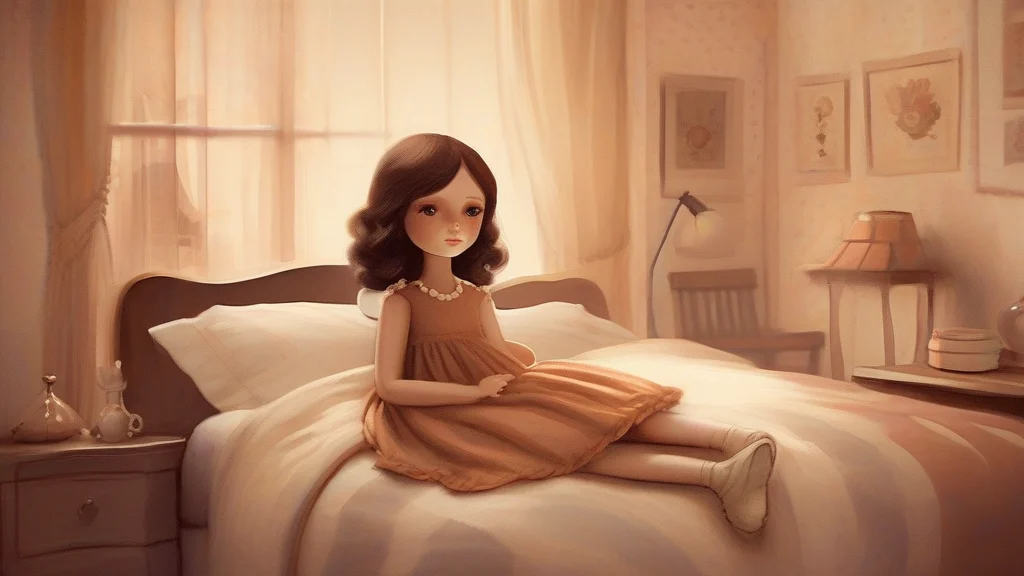
What does dolliness mean?
Dolliness is the quality of resembling a doll — typically a small, delicate, prettily made-up face or figure with an almost unnaturally flawless finish. It is most often applied to people, especially women and children whose large eyes, smooth skin, or neat features evoke the look of a toy, though it can describe objects, décor, or styling as well. The word carries an ambivalent connotation: at its best, dolliness suggests charm, cuteness, and dainty appeal; at its worst, it hints at something artificial, stiff, or lifeless, as though the person were more ornament than individual. Writers in fashion and criticism reach for it precisely because of this double edge — it praises while quietly withholding full approval. Formed from "doll" plus the noun-forming suffix "-iness," it remains a relatively rare term, encountered more often in descriptive journalism than in ordinary conversation, where phrases like "doll-like" are more usual.
nounThe quality or state of resembling a doll; a pretty but often artificial or lifeless prettiness of appearance.
- A doll-like quality of appearance, especially a pretty, delicate, or artificially perfect look.
"Her wide eyes and porcelain complexion lent her an air of dolliness that photographers adored."
"The costume designer exaggerated the actress's dolliness with ringlet curls and rosy cheeks."
"There was a certain dolliness to the mannequins that made the display window feel oddly cold."
Dolliness sounds like praise, but call someone's beauty "doll-like" and you may be hinting it looks manufactured rather than alive.
Reviewed by Deb Chak, Editor. AI-assisted content curated by RJS Tech Solutions LLP.
Etymology of dolliness
Dolliness is formed transparently from the English noun "doll," itself attested from around the sixteenth century as a pet form of the name Dorothy, combined with the common noun-forming suffix "-iness," which turns adjectives into nouns denoting a state or quality. Its closest relatives are therefore not ancient cognates but other derivatives of "doll," such as "dolly" and "dollish." The word has never been common, appearing chiefly in descriptive and critical writing when a doll-like quality of appearance needs naming.
Related word forms
How dolliness is actually used
Rare and informal in everyday use; more common in fashion writing and descriptive prose. The connotation can be ambivalent — suggesting charm and prettiness, but also stiffness, artificiality, or a lack of vitality.
Easily confused with dolliness
"Dalliance" means flirtatious play or a casual romantic involvement, whereas "dolliness" refers simply to a doll-like quality of appearance.