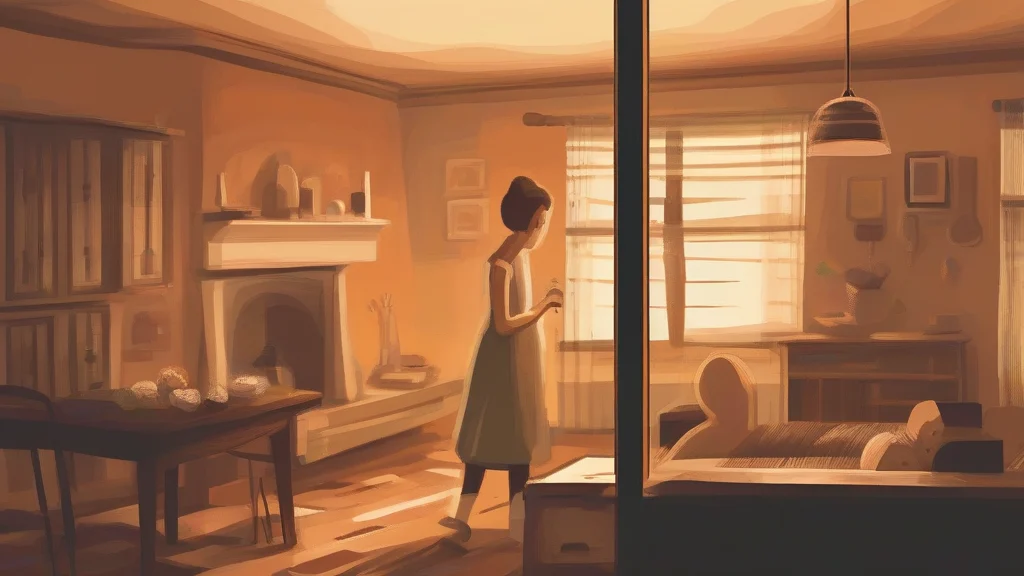
What does domesticity mean?
Domesticity is a noun describing the quality or state of being devoted to home life — the everyday rhythms of cooking, cleaning, raising children, and keeping house that make up ordinary family existence. It also denotes a settled, home-loving disposition, as opposed to a taste for travel, adventure, or public affairs. The word often appears in warm, affectionate contexts such as "domestic bliss" or "the quiet domesticity of village life," evoking comfort, intimacy, and routine. Yet it can also be used ironically or critically, particularly in discussions of gender roles and social history, where it evokes the idealisation of the homemaker and the confinement of women to the private sphere. Derived from the Latin domus, meaning "house," it entered English in the seventeenth century alongside related words like "domestic" and "domicile." Whether cherished or chafed against, domesticity names one of the most familiar textures of human experience.
The state or quality of being devoted to home life; the everyday activities, routines, and atmosphere of running a household.
"She found a quiet satisfaction in the domesticity of baking bread on cold mornings."
Uncountable in standard usage.
A settled, home-loving disposition; contentment with staying at home rather than seeking adventure or public life.
"His youthful wanderlust gave way, in middle age, to a pronounced domesticity."
Rarely used; the noun is almost always uncountable. A plural occasionally appears in literary or older writing to denote instances or manifestations of home life.
"The novel catalogues the small domesticities of married life — the shared cups of tea, the folded laundry."
"Domestic bliss" wasn't always a compliment — in Victorian times, an entire ideology of 'separate spheres' was built around the word, confining women to the home in its name.
Reviewed by Deb Chak, Editor. AI-assisted content curated by RJS Tech Solutions LLP.
Etymology of domesticity
Domesticity derives from the Latin domesticus, meaning "of the house" or "belonging to the home," itself formed from domus, the Latin word for "house" or "home." The word entered English in the early seventeenth century, following closely behind the adjective "domestic." It shares this root with "domicile," "domesticate," and ultimately with "dominion" and "dominate," which trace back through dominus, "lord or master of a house." Its cognates appear across the Romance languages, including French domesticité and Spanish domesticidad.
Related word forms
How domesticity is actually used
The word is neutral to warmly positive when describing comfort and contentment at home ("domestic bliss"), but it can carry a faintly ironic or slightly dismissive tone when contrasting a settled home life with adventure, ambition, or public life. It is a mass noun: it takes no plural in ordinary use.
Easily confused with domesticity
"Domesticity" refers to home life and household matters, while "domestication" refers to the process of taming animals or adapting plants for human use.