What does domino mean?
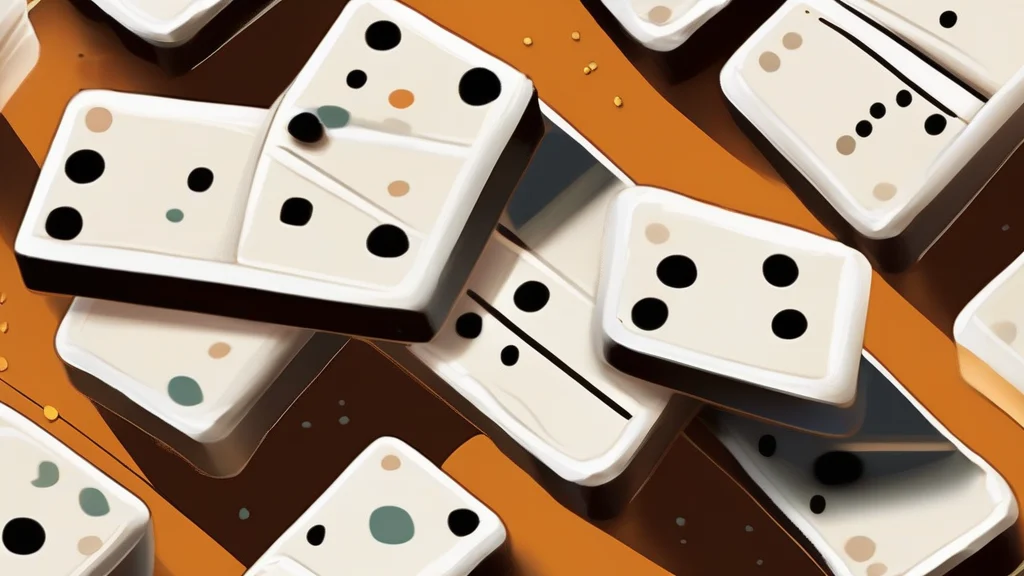
A domino is a small, flat rectangular tile, typically divided into two square halves marked with dots called pips, used to play the matching game known as dominoes. Players lay tiles so that adjacent halves show matching numbers, aiming to be the first to empty their hand. The word also names the game itself, and by extension any chain of events in which each step triggers the next — the familiar 'domino effect', famously applied to the spread of political influence during the Cold War. A now largely historical sense refers to a loose hooded cloak worn with a half-mask at masquerade balls. The word entered English in the early eighteenth century from French, ultimately from Latin dominus, meaning 'lord' or 'master', possibly because the costume resembled a priest's hooded garment. Today domino evokes both cozy family game nights and vivid imagery of cascading consequences.
One of a set of small rectangular tiles with pips on their faces, used in the game of dominoes; the game itself.
"He shuffled the dominoes face down before dealing seven to each player."
A loose hooded cloak, worn with an eye mask, at masquerade balls; sometimes the mask alone.
"She swept into the ballroom disguised in a black silk domino, her identity concealed behind the mask."
Now chiefly historical or found in literature about the eighteenth and nineteenth centuries.
Figuratively, an element in a chain reaction in which each event precipitates the next, as in the 'domino effect'.
"Analysts warned that if one bank failed, the rest would fall like dominoes."
Almost always used in the phrases 'domino effect' or 'fall/topple like dominoes'.
'Dominoes' is the standard plural, used both for individual tiles and for the game ('to play dominoes'). The informal spelling 'dominos' occurs, mainly in American usage, but is not preferred in careful writing.
"The set contained twenty-eight dominoes, enough for four players."
The domino got its name from the Latin for 'lord' — because the black-and-white tiles were said to resemble a priest's winter cloak, which was also called a domino.
Reviewed by Deb Chak, Editor. AI-assisted content curated by RJS Tech Solutions LLP.
Etymology of domino
The word domino entered English in the early eighteenth century from French, where it originally denoted the hooded cloak and mask worn at masquerades. It derives ultimately from Latin dominus, meaning 'lord' or 'master'; the costume sense may reflect resemblance to a priest's or academic's hooded garment, or a ritual exclamation spoken by costumed revelers. The gaming-tile sense arose later, apparently by transfer from the costume term. The same Latin root gives English cognates such as dominate, dominion, and domain.
How domino is actually used
In modern usage the word overwhelmingly refers to the tiles or the game; the masquerade sense is now largely historical or literary. The plural is usually 'dominoes' when referring to the tiles or the game, though 'dominos' appears informally, particularly in American usage.
Easily confused with domino
Dominion means sovereignty or control over territory, while a domino is a gaming tile or a masked costume — they share only a distant root meaning 'lord' or 'master'.