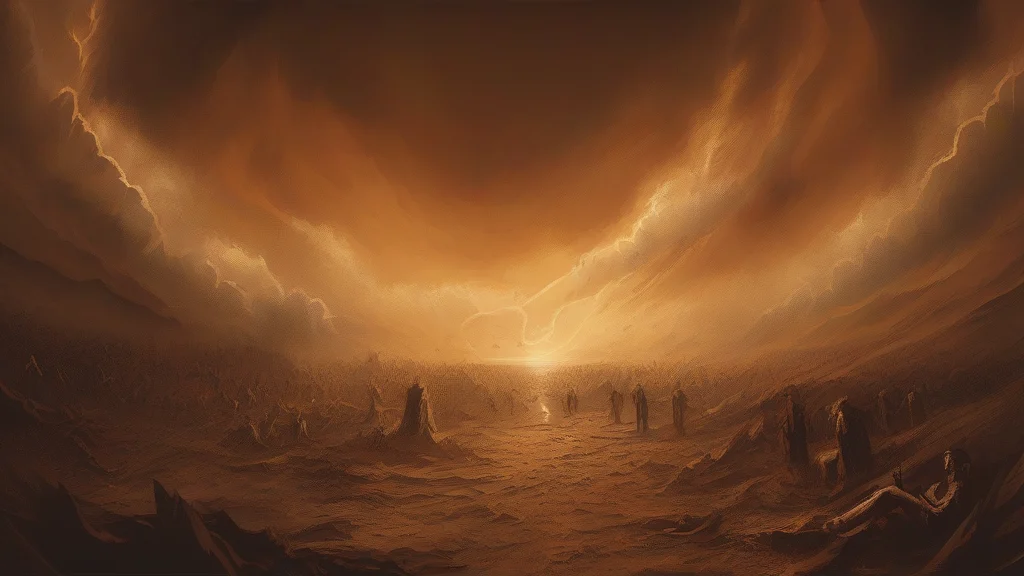
What does doomsday mean?
Doomsday denotes the final day of the world as imagined in Christian tradition — the Day of Judgment, when the dead are raised and all souls are judged by God. Over time the word broadened beyond theology to mean any moment of ultimate catastrophe or collapse, whether literal or figurative. Modern English uses it heavily as an adjective: a doomsday scenario describes the worst possible outcome, a doomsday clock symbolizes proximity to global disaster, and doomsday preppers stockpile supplies against civilizational breakdown. The word carries strong connotations of finality, dread, and inevitability, which makes it a favorite of journalists and commentators seeking dramatic emphasis — though this very drama can render it hyperbolic in everyday use. Its history is notable: the Domesday Book of 1086 took its name from the same root, because its judgments were considered as final as those of the Last Judgment. Few words so compactly capture both ancient religious awe and contemporary anxiety about endings.
nounThe day of the Last Judgment at the end of the world in Christian eschatology; more broadly, any final or catastrophic day on which disaster or destruction is expected.
- In Christian belief, the day of the Last Judgment, when God judges all souls and the world ends.
- Any final, catastrophic day marking the end or destruction of something, used literally or hyperbolically.
"Environmentalists warned that ignoring climate change was hastening humanity's own doomsday."
"According to medieval belief, sinners faced eternal punishment on doomsday."
"The company's collapsing finances painted a doomsday picture for its investors."
Rarely pluralized since the word typically refers to a singular final event; the plural appears mainly in reference to multiple predicted or hypothetical末日 scenarios.
"Preachers across the centuries have announced their own doomsdays, each one failing to arrive."
When medieval scribes wrote "Domesday" for William the Conqueror's great land survey of 1086, they chose the name deliberately — like the Day of Judgment, its rulings would be final and open to no appeal.
Reviewed by Deb Chak, Editor. AI-assisted content curated by RJS Tech Solutions LLP.
Etymology of doomsday
Doomsday descends from Old English "dōmdæg," a compound of "dōm" (judgment, statute — the same root behind the verb "deem") and "dæg" (day). It originally referred strictly to the Christian Day of Judgment, a sense preserved in William Langland's Middle English poem "Piers Plowman." The related form "Domesday" survives in the Domesday Book, the 1086 Norman survey of England named for the finality of its judgments. From its religious core, the meaning widened over the centuries to cover any terminal or apocalyptic day, giving rise to modern compounds such as doomsday scenario and doomsday clock.
Related word forms
How doomsday is actually used
Often used attributively as an adjective (a doomsday scenario, a doomsday cult). In secular contexts it frequently carries hyperbolic or alarmist overtones, so it can sound dramatic or informal when applied to everyday setbacks.
Easily confused with doomsday
"Domesday" refers specifically to the Domesday Book of 1086, William the Conqueror's survey of English landholdings (spelled with a single 's' historically), whereas "doomsday" means the end of the world or a final day of judgment.