What does doorknocker mean?
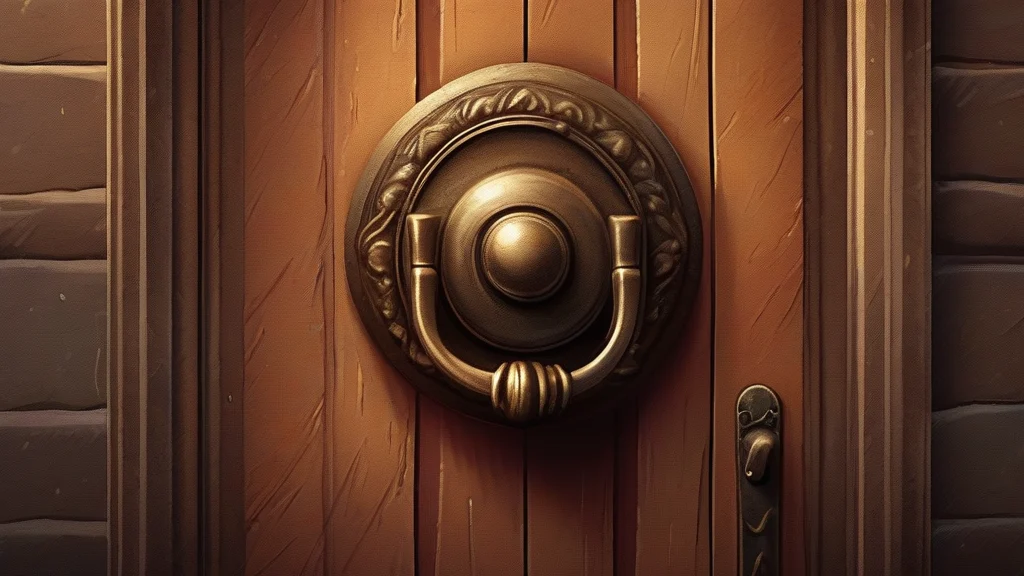
A doorknocker is a metal fitting mounted on an exterior door, designed to be lifted and struck against the door's surface to announce a visitor's arrival. Usually made of brass, iron, or another durable metal, it commonly takes the form of a ring suspended from a plate, though decorative shapes — most famously the lion's head — have been popular for centuries. The doorknocker predates the electric doorbell and remains in use today, particularly on period homes where it is valued as much for its appearance as its function. The word is standard in both British and American English, typically spelled as one word, and carries no particular connotation of formality or informality. In everyday speech, doorknocker can occasionally refer to a person who knocks on doors, as in a salesperson or canvasser, though this sense is less common than the hardware meaning. For writers, the word is useful for evoking traditional domestic settings and the tactile rituals of arriving at someone's home.
nounA doorknocker is a fixed metal fitting on an exterior door, typically shaped like a ring or handle attached to a plate, that is raised and struck against the door to announce a visitor's presence. It serves the same function as a doorbell but relies on physical knocking.
- A metal fixture mounted on an exterior door that is lifted and struck against the door to alert occupants to a visitor's arrival.
"The brass doorknocker, polished by generations of visitors, gleamed in the afternoon light."
"She hesitated for a moment before lifting the heavy iron doorknocker and letting it fall three times."
"Victorian houses often featured ornate doorknockers cast in the shape of lions' heads or classical figures."
The plural follows regular English noun inflection. It appears most often when discussing collections of fittings, architectural styles, or multiple properties.
"The antique shop displayed dozens of doorknockers salvaged from demolished townhouses."
Before electricity reached the front step, every visitor had to make their own noise — which is why some of history's grandest homes still bear lion-head knockers heavy enough to wake the whole street.
Reviewed by Deb Chak, Editor. AI-assisted content curated by RJS Tech Solutions LLP.
Etymology of doorknocker
The word doorknocker is a straightforward compound of "door," from Old English "duru" or "dor," and "knocker," the agent noun formed from the verb "knock," which entered Middle English likely from Old Norse "knoka" (to knock). The compound arose naturally once doors themselves became objects worth describing in detail, and it parallels other "door-" compounds such as doorknob and doorknob's sibling doorbell. Its cognates are essentially the Germanic words sharing the root of "knock" — related forms appear across Scandinavian languages, while the compound itself is an English formation with no direct equivalent borrowed from Latin or Greek.
Related word forms
How doorknocker is actually used
Doorknocker is a neutral, everyday term with no strong register — it appears equally in casual conversation and descriptive writing. It is written as one word in standard modern usage, though the two-word form "door knocker" is also widely accepted. The word is common in both British and American English, and is especially frequent in descriptions of older or historic properties where such fittings are architectural features worth noting.
Easily confused with doorknocker
A doorbell is an electric or mechanical device that chimes when pressed, while a doorknocker is a manual metal implement that must be physically lifted and struck against the door.