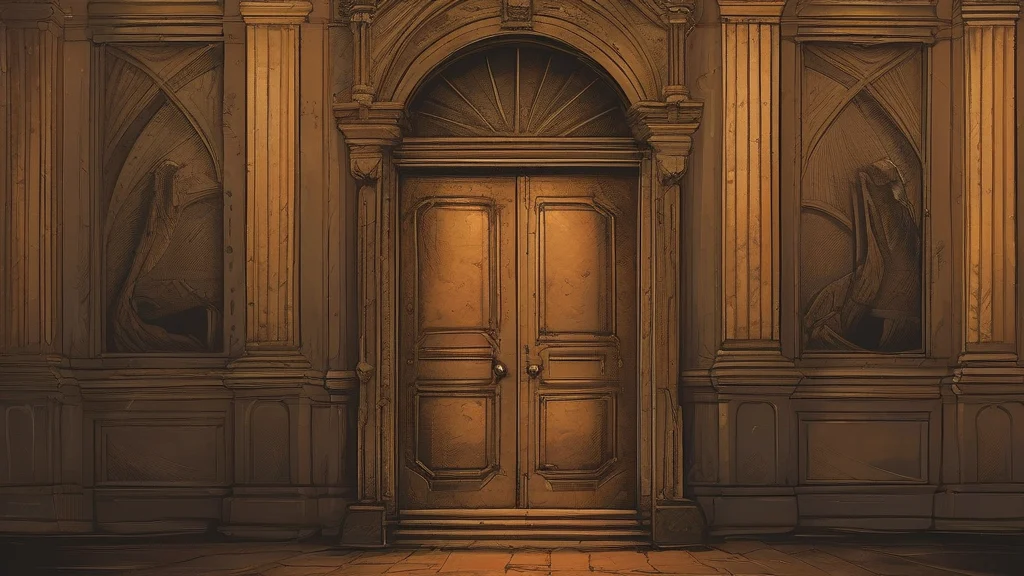
What does dore mean?
"Dore" is an archaic spelling of "door," the familiar noun for the hinged, sliding, or otherwise movable barrier that closes an opening in a wall, allowing entry and exit. Before spelling conventions settled in the early modern period, English writers rendered the word variously as "dore," "doore," and "dure," so modern readers most often meet "dore" in medieval manuscripts, early printed books, or historical transcriptions rather than in current prose. A distinct but related form is the French loan "doré," an adjective meaning gilded or finished in gold, which survives today in art-historical and antiques contexts — as in "ormolu and doré bronze" — describing decorative metalwork. Because the unaccented spelling is no longer current, writers should use "door" in all ordinary contexts and reserve "doré" for technical descriptions of gilded objects. Anyone researching older texts should recognize "dore" instantly as a variant, not a separate word.
noun"Dore" is chiefly an archaic or obsolete spelling of "door," the movable barrier that opens an entrance to a building or room. In its accented French-derived form "doré," it functions as an adjective meaning gilded or decorated in gold.
- An archaic or obsolete spelling of "door": a movable barrier at the entrance to a building, room, or vehicle.
- (As "doré") Gilded; covered or ornamented with gold.
"The manuscript's marginal note read only "dore," a spelling long since abandoned."
"The inventory listed one iron-bound dore at the mill's entrance."
"The frame was finished in antique doré bronze, glinting softly under the gallery lights."
In the texts where this archaic spelling appears, the plural is typically written "dores."
"The great hall had dores at either end."
Every time you write "door," you're quietly correcting centuries of medieval scribes who spelled it "dore" without a second thought.
Reviewed by Deb Chak, Editor. AI-assisted content curated by RJS Tech Solutions LLP.
Etymology of dore
The spelling "dore" descends from Old English "duru" (also "doru"), a common Germanic word whose relatives appear across the family — compare Old Norse "dyrr" and German "Tür." Middle English scribes wrote it in several forms, including "dore" and "doore," before standardization favored "door." The gilded adjective "doré" comes separately from Old French "doré," the past participle of "dorer" (to gild), itself from Latin "deaurare," built on "aurum," gold.
How dore is actually used
As a standalone modern English word, "dore" is effectively obsolete; readers will encounter it mainly in older texts, dialect records, or proper names such as the river Dore in Herefordshire. The gilded sense survives almost exclusively in the accented borrowing "doré," common in art and antiques terminology.
Easily confused with dore
"Dour" is an adjective meaning stern, gloomy, or unyielding in manner, whereas "dore" is simply an obsolete spelling of the noun "door."