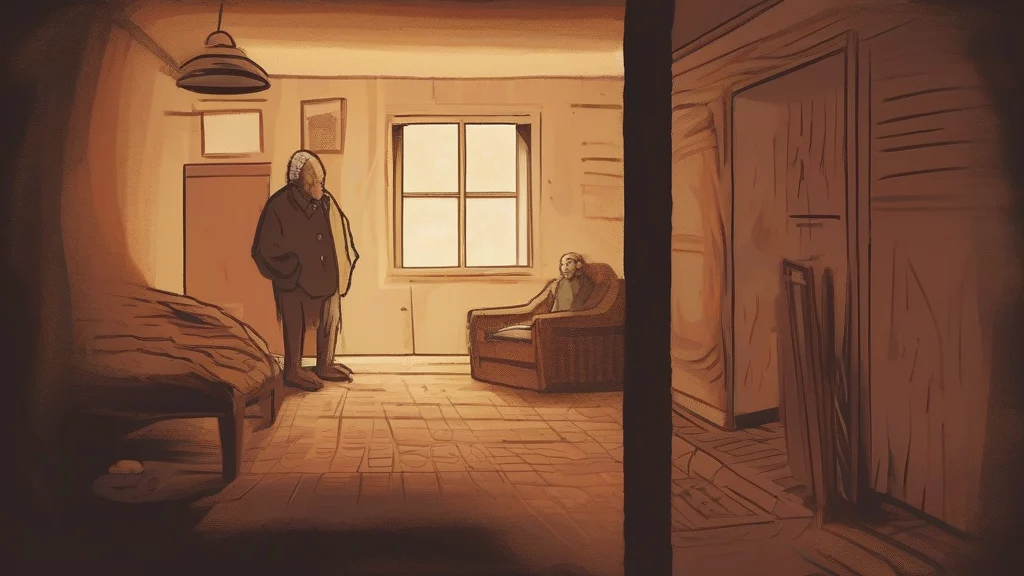
What does dotage mean?
Dotage refers to the period of life in which someone is very old and, typically, experiencing a decline in mental faculties — a state often described as senility or second childhood. The word is almost always used with a possessive pronoun in the fixed phrase 'in one's dotage,' as when we say an heirloom was sold 'while grandfather was in his dotage.' It belongs to a formal or literary register: everyday conversation favors plainer terms like 'old age' or more clinical ones like 'dementia,' whereas 'dotage' lends writing a slightly archaic, elegiac flavor. Its connotations are gently negative or pitying rather than cruel, emphasizing frailty and diminished judgment rather than age alone. The noun derives from the verb 'dote,' which once meant to be foolish or weak-minded before narrowing to its modern sense of excessive fondness. A related form, 'dotard,' describes an elderly person in such decline. Though less common today than it once was, 'dotage' remains a precise, evocative way to mark the twilight years when the mind begins to fade.
nounThe period of life in which a person is old and weak, especially with declining mental faculties; a state of senility or feeble-mindedness associated with extreme old age.
- The period or state of old age marked by decline in mental faculties; senility.
- (Less common, chiefly archaic) Excessive fondness or foolish affection; doting.
"In his dotage, the old professor spent his days tending roses and telling the same stories to anyone who would listen."
"She remained sharp well into her nineties, refusing to accept that she had entered her dotage."
"The estate was signed away while the earl was in his dotage and no longer able to manage his affairs."
Rarely pluralized; the word is nearly always used in the singular, typically with a possessive pronoun.
"The novel contrasts the vigorous youth of its heroine with her quiet, forgetful dotages in later life."
Shakespeare's Lear was 'full of wise saws and modern instances' only after his wits had gone — English has had 'dotage' for over six centuries to describe that exact fate.
Reviewed by Deb Chak, Editor. AI-assisted content curated by RJS Tech Solutions LLP.
Etymology of dotage
Dotage derives from the Middle English verb 'doten,' meaning to be foolish or weak-minded, which is of Germanic origin. In its early history, the noun referred simply to foolishness or imbecility, and only later came to denote specifically the mental decline of extreme old age. The same root gives us 'dote' (originally 'to be foolish,' later 'to show foolish affection') and 'dotard,' an elderly person in their dotage. The word has been part of English since the medieval period.
How dotage is actually used
Formal or literary register; often used with the possessive ('his dotage', 'her dotage') in the phrase 'in one's dotage.' It carries a somewhat negative or pitying connotation, implying diminished mental capacity rather than mere old age.
Easily confused with dotage
'Dote' is a verb meaning to show excessive love or fondness (often 'dote on'), while 'dotage' is a noun referring to the mental decline of extreme old age — though both share the same root.