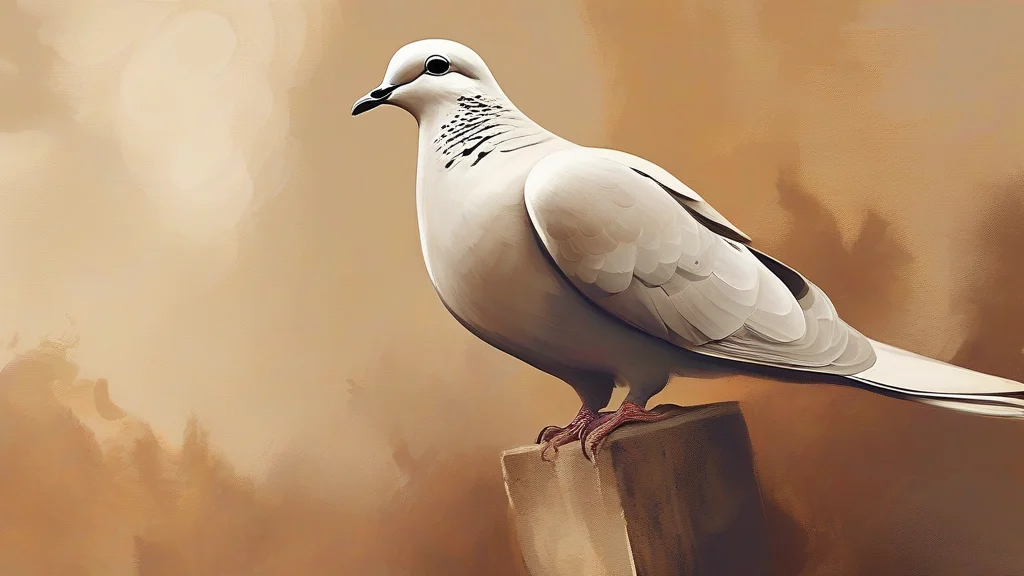
What does dove mean?
A dove is a bird belonging to the pigeon family, Columbidae, the word most often reserved for smaller species such as the mourning dove or turtledove, while larger birds are commonly called pigeons. Beyond its ornithological meaning, the dove is one of the world's most enduring symbols of peace and gentleness, an association stretching back to the biblical story of Noah, in which a dove returns to the ark bearing an olive branch. By extension, a "dove" can describe a person who favors negotiation over confrontation, particularly in politics, standing opposite the "hawk." In American English, "dove" also serves as the simple past tense of the verb "dive," as in "she dove off the diving board," though British English typically uses "dived." Whether describing a bird, a peacemaker, or a plunge into water, the word carries connotations of grace and softness that have kept it central to literature, religion, and everyday speech.
A bird of the pigeon family (Columbidae), typically smaller than a pigeon, noted for its soft cooing; a traditional emblem of peace and gentleness.
"The bride released a white dove as the guests looked on."
Often used figuratively to mean a person who advocates peace, especially against a "hawk."
Simple past tense of "dive": plunged headfirst or descended rapidly through air or water.
"He dove from the high board without hesitation."
Common chiefly in American English; British English generally prefers "dived."
Regular plural formation by adding -s; standard in both British and American English.
"Doves gathered on the ledge outside her window each morning."
The dove has been a symbol of peace since at least the biblical story of Noah, when it returned to the ark carrying an olive leaf.
Reviewed by Deb Chak, Editor. AI-assisted content curated by RJS Tech Solutions LLP.
Etymology of dove
The word "dove" comes from Old English "dūfe," a word of Germanic origin related to Old Norse and Dutch counterparts, though its precise deeper ancestry remains uncertain. It has been part of the language since before the twelfth century, making it one of the oldest surviving native bird names in English. The association with peace derives not from the word's origin but from its long-standing symbolism in biblical and classical tradition. Its Germanic roots distinguish it from Latinate synonyms such as "columbine," which traces back to Latin "columba," the classical word for the same bird.
Related word forms
How dove is actually used
As a noun, "dove" is neutral to slightly literary in register and carries strongly positive connotations of peace, innocence, and tenderness. In political contexts, calling someone a "dove" contrasts them with a "hawk." Note that "dove" is also the common American past tense of the verb "dive" (British English prefers "dived"), so context determines which meaning applies.
Easily confused with dove
"Dove" is also the simple past tense of the verb "dive" (she dove into the pool), whereas the noun refers to the bird; the two share spelling and sound but are entirely different words.
"Pigeon" and "dove" refer to closely related birds of the same family, with "dove" usually applied to smaller species or used in literary and symbolic contexts.