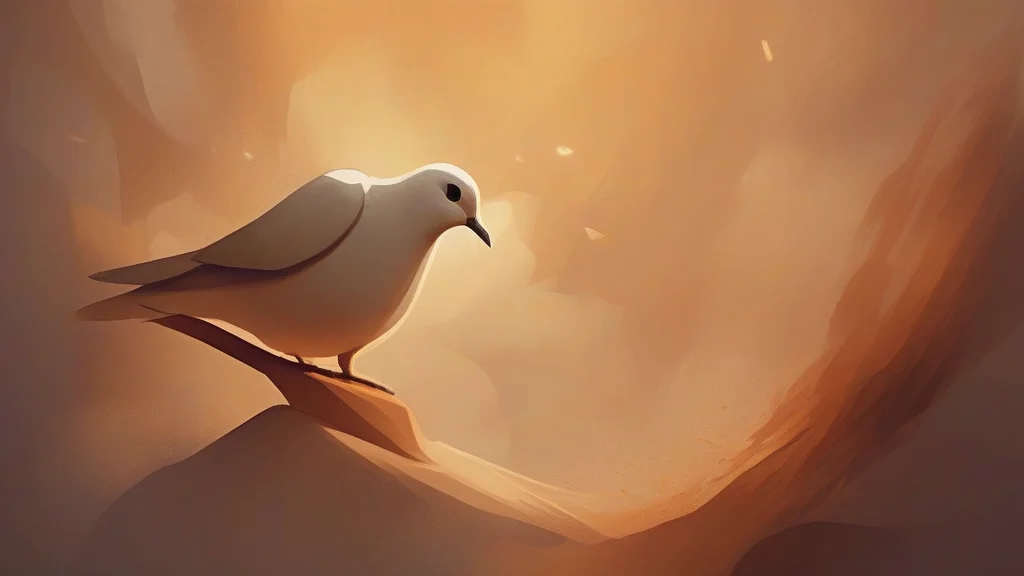
What does dovelike mean?
Dovelike is an adjective meaning resembling a dove, applied both literally and figuratively. In its literal sense it describes something that looks like the bird — soft grey-and-white coloring, plump contours, or gentle winged movement. More often it is used figuratively to characterize a person or manner as gentle, innocent, mild, or peaceable, drawing on the dove's long-standing symbolism as an emblem of peace, purity, and tenderness. A negotiator with dovelike patience, for example, is calm and unthreatening even under provocation. The word belongs chiefly to literary and descriptive registers; it appears more often in poetry, fiction, and elegant journalism than in casual speech, where simpler words like "gentle" usually serve instead. Its connotations are almost entirely favorable, suggesting harmlessness and serenity. The natural contrast is hawklike, which implies aggression or predatory keenness, and this pairing echoes the familiar political division between "doves," who favor conciliation, and "hawks," who favor confrontation.
adjectiveResembling a dove, especially in being gentle, peaceful, innocent, or mild in manner or appearance.
- Resembling a dove in appearance or form.
- Gentle, innocent, or peaceable in temperament or manner.
"She regarded the squabbling committee members with a dovelike calm."
"The bride wore white feathers pinned in a dovelike arrangement at her shoulder."
"Despite years in politics, he retained a dovelike innocence that disarmed his critics."
Doves have symbolized peace since ancient Mesopotamia — so to be dovelike is to carry five thousand years of peacemaking in one little word.
Reviewed by Deb Chak, Editor. AI-assisted content curated by RJS Tech Solutions LLP.
Etymology of dovelike
Dovelike is formed transparently within English from the noun "dove" plus the suffix "-like," which creates adjectives meaning resembling or characteristic of. The noun dove itself derives from Old English dūfe, a word of Germanic origin related to similar forms in other Germanic languages. Compound adjectives built with "-like" are a productive pattern in English, appearing from Middle English onward, and dovelike follows this well-established model. Its closest relatives are therefore other native compounds sharing either the bird name (such as dovecote) or the suffix (such as childlike and warlike).
How dovelike is actually used
A literary and somewhat rare word, more likely to appear in poetry, fiction, and descriptive prose than in everyday conversation. It carries warm, positive connotations of purity and tranquility. It can describe both physical resemblance (soft coloring, rounded shape) and character (gentleness, harmlessness), though the figurative sense is more common.
Easily confused with dovelike
"Dovish" describes a person's political stance favoring peace and negotiation over conflict (especially in foreign policy), while "dovelike" describes resemblance to the bird dove in gentleness or appearance.