
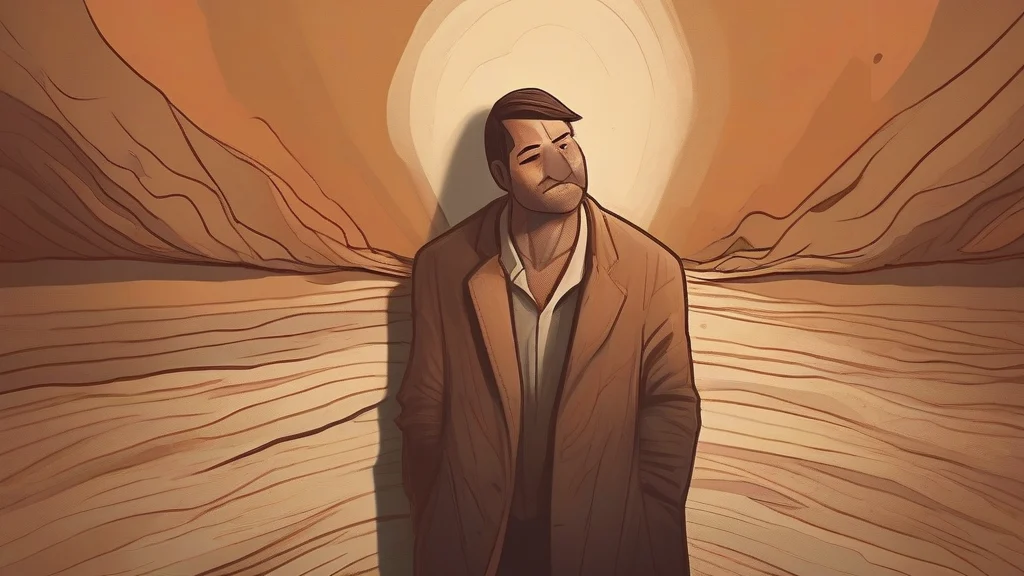
What does downturned mean?
"Downturned" is an adjective used to describe something that points, curves, or slopes downward. It appears most often in descriptions of the human face — a downturned mouth or downturned eyes suggest sadness, disappointment, or disapproval — but it applies equally to physical objects, as in a downturned brim of a hat or the downturned spout of a jug. The word is formed from "down" plus "turned," the past participle of "turn," and it relates closely to the noun "downturn," which refers to a decline in economic activity. Because facial expression carries strong emotional weight, "downturned" often conveys a subtly negative tone even when used purely descriptively; writers and makeup artists alike rely on it to signal mood at a glance. It is standard in both British and American English and suits both everyday and formal registers.
adjectivePointing or curving downward, especially of the corners of the mouth, eyes, or other features. More generally, directed or oriented in a downward direction.
- (of facial features such as the mouth or eyes) curving or pointing downward, often suggesting sadness or disapproval
- (of physical objects) angled, tilted, or directed downward
"She greeted the news with a downturned mouth and a slow shake of the head."
"His downturned lips gave away his disappointment before he said a word."
"The lamp had a downturned shade that cast light directly onto the desk."
A downturned mouth is one of the few facial expressions humans can read instantly from across a room — no words required.
Reviewed by Deb Chak, Editor. AI-assisted content curated by RJS Tech Solutions LLP.
Etymology of downturned
"Downturned" is a transparent English compound formed from the adverb "down" and the past participle "turned" of the verb "turn." "Turn" derives from Old French "tourner," from Latin "tornare," meaning to turn on a lathe, itself from Greek "tornos" (a lathe or carpenter's tool). "Down" comes from Old English "dūne," originally meaning "from the hill." The word arose through ordinary English compounding rather than borrowing, developing alongside related formations such as "downturn" and "downward."
Related word forms
How downturned is actually used
"Downturned" is most frequently used in descriptions of faces and body language, particularly the mouth and the outer corners of the eyes (as in "downturned eyes," a common term in beauty and makeup writing). It carries a mildly negative connotation when applied to expressions, since a downturned mouth conventionally signals sadness, displeasure, or disapproval. In technical or design contexts it is neutral, simply indicating direction.
Easily confused with downturned
"Downturn" is a noun meaning a decline in economic or business activity, while "downturned" is an adjective describing something physically angled downward.