
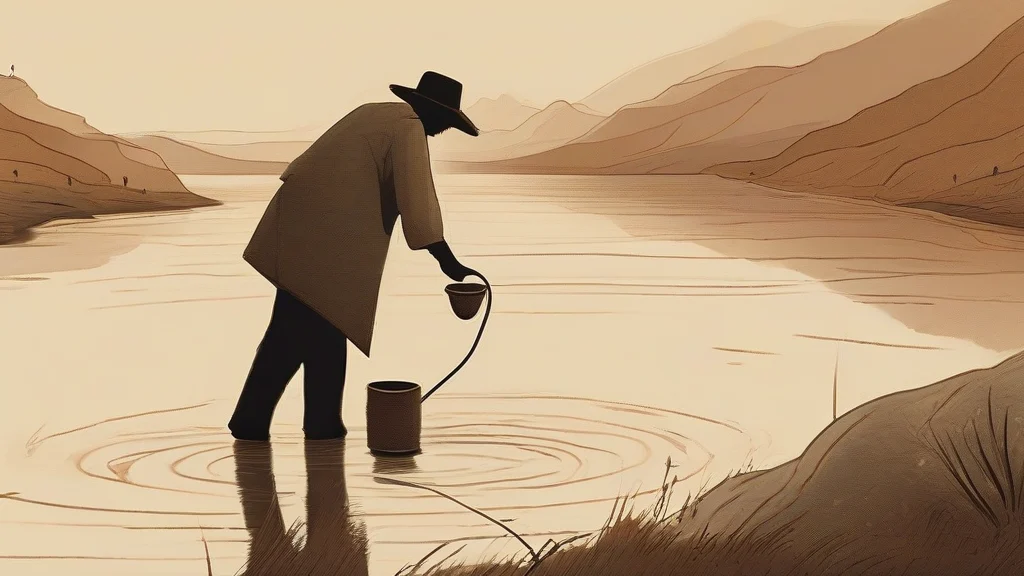
What does dowsing mean?
Dowsing is a folk practice in which a person attempts to locate underground water, minerals, buried objects, or other hidden substances using a hand-held instrument such as a forked wooden twig, metal rods, or a pendulum. As the dowser walks over the search area, movements of the instrument — typically a twitching of the rod or swinging of the pendulum — are interpreted as signs of the target's presence beneath the surface. Known in Britain as water divining, the practice has been used for centuries, particularly to find well sites in rural communities. Despite its long history and enduring popularity among some practitioners, controlled scientific testing has repeatedly failed to show that dowsing performs better than random chance; successes are generally attributed to the ideomotor effect, in which unconscious muscle movements guide the instrument. Today the word appears most often in discussions of folklore, rural tradition, and skepticism.
nounA method of searching for underground water, minerals, or other hidden objects using a forked rod or pendulum held by a practitioner who interprets its movements.
- Searching for underground water, minerals, or buried objects using a forked stick, rods, or pendulum whose movements are interpreted as indicating the target's location.
"The farmer hired a local expert in dowsing to locate a new well on his property."
"Armed with nothing but a bent coat hanger, he took up dowsing along the dry creek bed."
"Skeptics argue that any success in dowsing can be explained by the ideomotor effect rather than hidden water."
Despite centuries of use and thousands of devoted practitioners, no scientific study has ever shown that dowsing works better than chance — yet it's still used today.
Reviewed by Deb Chak, Editor. AI-assisted content curated by RJS Tech Solutions LLP.
Etymology of dowsing
Dowsing derives from the verb 'dowse', whose origin is uncertain but which emerged in English around the late 17th century, possibly related to 'douse', meaning to plunge into water. The term came to refer specifically to the practice of searching for underground water with a divining rod. In British usage the older term 'divining' remains common alongside it.
Related word forms
How dowsing is actually used
In British English the practice is often called 'water divining' or simply 'divining', and the practitioner is called a 'diviner'. The term carries a slightly folkloric, old-fashioned connotation and is frequently discussed in contexts of pseudoscience and skepticism.
Easily confused with dowsing
Dousing means drenching or extinguishing something with liquid (e.g. dousing a fire), whereas dowsing refers to searching for underground water or minerals with a rod or pendulum.