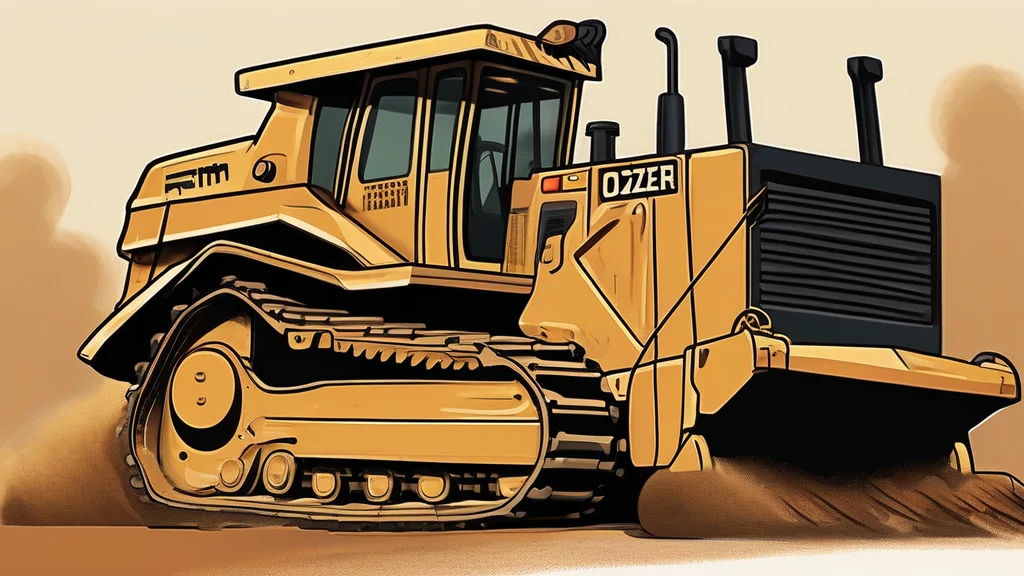
What does dozer mean?
Dozer has two distinct lives in English. Its older sense, formed simply by adding the agent suffix '-er' to the verb 'to doze', denotes anyone or anything that dozes — a person nodding off during a lecture, or a cat sleeping lightly through the afternoon. It carries a gently humorous, non-judgmental connotation, unlike harsher words such as 'idler'. In the twentieth century the word acquired a second, entirely unrelated-feeling sense as a casual shortening of 'bulldozer', the powerful tracked machine fitted with a broad steel blade for pushing soil, rubble, and snow. This usage is standard among operators and in the construction industry, though formal documents usually prefer the full term. The two senses coexist without confusion because context makes clear whether a sleepy human or a piece of heavy plant is meant. The word's compactness and vividness make it useful both in everyday description and in trade speech.
A person or animal that dozes; one who sleeps lightly or intermittently.
"By the third hour of the seminar, the back rows were full of quiet dozers."
Mildly humorous or descriptive register; not pejorative.
Informal shortening of bulldozer: a heavy tracked vehicle with a large metal blade used for clearing and moving earth.
"They hired a dozer to level the site before pouring the foundations."
Standard jargon in construction and mining; use 'bulldozer' in formal prose.
Regular plural, applies to both senses.
"Two dozers worked the ridge line all morning."
The same five letters that describe a cat napping in the sun also name the machine that flattens hillsides.
Reviewed by Deb Chak, Editor. AI-assisted content curated by RJS Tech Solutions LLP.
Etymology of dozer
The noun 'dozer' derives directly from the verb 'doze' plus the agentive suffix '-er'. 'Doze' itself appeared in the mid-17th century, probably as a variant or diminutive of 'douse', and is related to the Old Norse 'dusa', meaning to doze. The shortened form of 'bulldozer' arose in 20th-century American English alongside the spread of mechanized earthmoving equipment. Cognates include 'drowse' and 'dizzy', which share the Germanic root idea of dullness or stupor.
Related word forms
How dozer is actually used
Sense 1 is the agent noun from the verb 'doze' and appears mostly in descriptive or mildly humorous writing. Sense 2 is informal and common in construction and mining contexts, where it is fully accepted jargon; in formal technical writing 'bulldozer' is preferred.
Easily confused with dozer
A dosser is British slang for a lazy person or someone who lives rough, while a dozer is either someone who dozes or a bulldozer.
The dozer is the whole machine, whereas the dozer blade is only the large metal plate mounted on its front for pushing material.