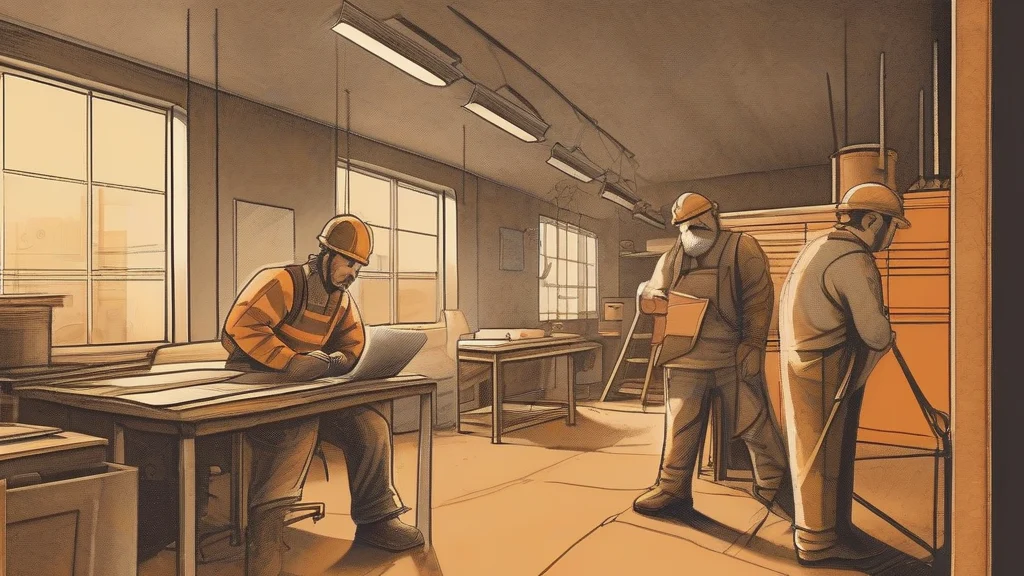
What does draftsmen mean?
Draftsmen is the plural of draftsman — the British form being draughtsmen — and refers to people who prepare detailed technical drawings, plans, and diagrams, typically for architects, engineers, and manufacturers. Before computer-aided design transformed the profession, draftsmen worked at drafting boards with pencils, rulers, compasses, and T-squares, translating concepts into precise, scaled representations that builders could follow. The term can also be used more broadly to praise someone who composes written documents with exceptional skill, as in describing an accomplished draftsman of legislation. Because the word carries the suffix '-man', modern usage increasingly favours neutral alternatives such as 'drafters' or 'drafting technicians'. The American spelling uses 'draft-', while British English retains the older 'draught-'; both derive from the verb 'to draw'. Today the plural appears most often in historical, professional, or formal contexts.
People whose job is to make detailed technical drawings or plans of buildings, machines, or other objects.
"In the 1950s, large firms employed dozens of draftsmen at rows of drafting tables."
Gender-neutral alternatives such as 'drafters' or 'drafting technicians' are now often preferred.
People who write or compose documents, especially legal or official texts, with notable skill.
"The constitution was shaped by brilliant draftsmen who weighed every word carefully."
This is already the plural form; the singular is 'draftsman'. The feminine or gender-neutral forms are 'draftswoman'/'draftswomen' and 'draftsperson'.
"The studio's draftsmen completed the plans ahead of schedule."
Before CAD software existed, entire buildings were brought to life by hand by draftsmen — and the word itself is built from 'draw', making a draftsman literally a man who draws for a living.
Reviewed by Deb Chak, Editor. AI-assisted content curated by RJS Tech Solutions LLP.
Etymology of draftsmen
Draftsmen comes from 'draftsman', a compound of 'draft' (a variant of 'draw') and the agentive suffix '-man', formed in English around the late seventeenth century to denote someone who draws up plans or documents. 'Draw' descends from Old English 'dragan', meaning to drag or pull, which also gave rise to 'drag' and to 'draft/draught' as words for something drawn up — a sketch, a current of air, or money drawn from a bank. The British spelling preserves 'draught', reflecting Middle English vowel conventions, while American usage standardized on 'draft' in the eighteenth century. Cognates within English include 'draw', 'drawing', 'redraw', and 'withdraw'.
Related word forms
How draftsmen is actually used
Because the word contains '-man', many style guides and workplaces now prefer gender-neutral alternatives such as 'drafters', 'drafting technicians', or simply 'draftsperson'. The spelling is 'draft-' in American English and 'draught-' in British English.
Easily confused with draftsmen
'Draughtsmen' is simply the British spelling of the same word; in American English it is always spelled 'draftsmen'.