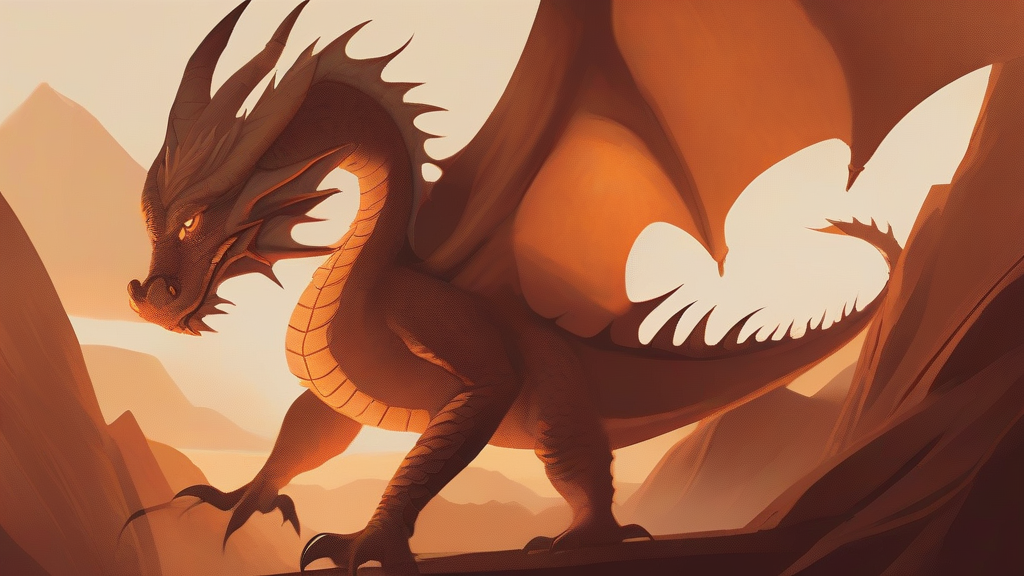
What does dragonlike mean?
Dragonlike is an adjective describing anything that resembles a dragon — whether in physical form or in spirit. It most commonly applies to creatures whose scaly hide, fierce eyes, or imposing size evoke the legendary monster, as in 'a dragonlike lizard' or 'the dragonlike silhouette of the rock formation.' Figuratively, it characterizes people or forces that are fierce, intimidating, or seemingly unstoppable: a dragonlike temper, a dragonlike appetite for conquest. The word is largely literary and descriptive rather than colloquial, appearing frequently in nature writing, fantasy fiction, journalism, and vivid characterization. Its connotations are dramatic and awe-struck rather than neutral — to call something dragonlike is to lend it grandeur and menace at once. Because it is formed transparently from the familiar noun dragon plus the suffix -like, its meaning is instantly graspable, making it a useful and evocative choice whenever ordinary adjectives like 'large' or 'scary' would fall flat.
adjectiveResembling a dragon in appearance, character, or behavior — especially in being fierce, formidable, or scaly.
- Resembling a dragon in appearance, such as scaly skin, wings, or fiery breath.
- Fierce, intimidating, or overpowering in manner or temperament.
"The lizard's dragonlike crest made it look like something out of legend."
"The komodo dragon's forked tongue and armored hide give it a distinctly dragonlike presence."
"Her dragonlike glare silenced the room before she said a word."
The word 'dragon' traces back to Greek 'drakōn,' meaning 'one who sees' — so to be dragonlike is, etymologically, to be sharp-eyed and watchful as well as fearsome.
Reviewed by Deb Chak, Editor. AI-assisted content curated by RJS Tech Solutions LLP.
Etymology of dragonlike
Dragonlike combines dragon, from Old French dragon, which derives from Latin dracōn, borrowed from Greek drakōn ('serpent, dragon'), with the native English adjective-forming suffix -like. The suffix -like comes from Old English gelīc, meaning 'having the body or form of.' The compound thus joins a classical Greek-Latin lineage with a Germanic English ending, a pattern typical of many English descriptive adjectives. Cognates of the root include draconic and dragoon.
How dragonlike is actually used
Dragonlike is most often found in descriptive or literary writing about animals, fantasy creatures, and vivid figurative portraits of people; it carries a connotation of awe or menace rather than everyday description.
Easily confused with dragonlike
Draconian means excessively harsh or severe (after the Athenian lawgiver Draco), while dragonlike describes resemblance to the mythical dragon itself.