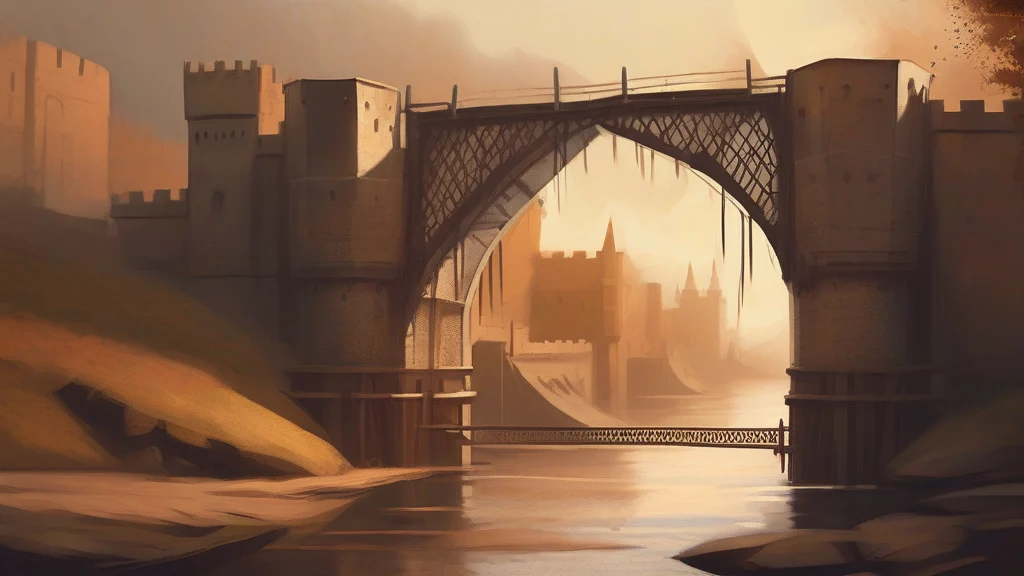
What does drawbridge mean?
A drawbridge is a type of bridge designed to be raised or lowered, allowing passage when down and blocking access when up. Its classic form dates to medieval fortifications: a hinged timber deck spanning a castle's moat, which could be hoisted by chains or ropes to deny entry to attackers and lowered to admit friends and supplies. The same principle survives today in civil engineering, where drawbridges lift, swing, or fold open to let ships pass along rivers and harbours while restoring road or rail traffic once vessels have cleared. Because the word evokes both impregnable castles and busy ports, it carries rich connotations of defence, control, and transition between openness and exclusion. It also appears figuratively in expressions such as 'raising the drawbridge', meaning shutting out outsiders, and 'drawbridge mentality', describing communities that resist newcomers.
nounA bridge, especially over a castle moat or canal, that can be raised or lowered to allow or prevent passage across it.
- A hinged bridge over a castle moat or ditch that can be raised to block entry.
- A movable bridge (as over a river or canal) that can be raised to let boats pass.
"The guards lowered the drawbridge at dawn to let the merchants into the castle."
"The enemy army halted before the raised drawbridge, unable to cross the moat."
"The old steel drawbridge swung open as the fishing trawler chugged through the channel."
Regular plural; used when referring to more than one such bridge.
"The Netherlands is famous for its hundreds of historic drawbridges."
Medieval castles could turn a road into a moat in seconds — the drawbridge was the original 'access denied' button.
Reviewed by Deb Chak, Editor. AI-assisted content curated by RJS Tech Solutions LLP.
Etymology of drawbridge
Drawbridge is a compound of the native English verb 'draw' (Old English dragan, meaning to pull or drag) and 'bridge' (Old English brycg), first recorded in Middle English around the 14th–15th century in reference to castle defences. The name reflects how the bridge was literally drawn upward by chains or ropes. Its components are thoroughly Germanic, making English cousins of words such as Dutch 'dragen' (to carry) and German 'tragen' (to bear) through shared Germanic roots.
How drawbridge is actually used
Neutral register. In modern usage it most often refers to movable bridges over waterways; its castle association is common in figurative and historical contexts. The phrase 'drawbridge mentality' describes an attitude of keeping others out once one has secured one's own position.
Easily confused with drawbridge
A portcullis is a heavy iron grating that slides down vertically to block a gateway, whereas a drawbridge is a hinged wooden or metal deck that lifts up.