What does drawer mean?
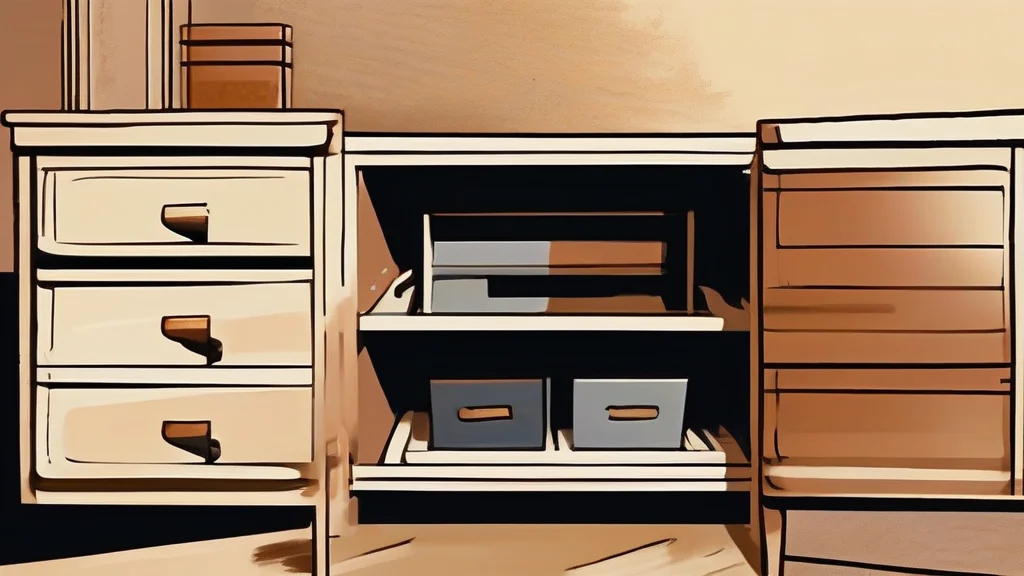
A drawer is a boxlike receptacle that slides in and out of a piece of furniture — a desk, dresser, chest, or cabinet — on runners or guides, providing enclosed storage for clothes, papers, utensils, and countless other household items. The word also has a secondary sense denoting a person who draws, as in sketches or illustrations, though this use is far less common than alternatives like artist or illustrator. Drawer appears constantly in everyday language, fixed into familiar phrases such as chest of drawers and top drawer, the latter extending figuratively to describe something of the highest quality. Pronunciation varies noticeably across English-speaking regions: while the standard forms rhyme with floor, many speakers reduce or drop the final syllable so that drawer sounds identical to the verb draw. Derived from the verb draw by addition of the agent suffix -er, the word literally means 'that which is drawn out', a tidy description of its function that has served English speakers since at least the sixteenth century.
A sliding, boxlike compartment in a piece of furniture, used for storing items.
"The carpenter fitted each drawer with brass handles."
A person who draws, especially one who produces sketches or illustrations.
"As a drawer of architectural studies, she had few equals."
The plural drawers refers to multiple compartments; note that in British English 'drawers' can also be an old-fashioned term for undergarments, a separate sense entirely.
"All six drawers of the dresser were stuffed with winter clothes."
In many American and British accents, 'drawer' collapses to sound exactly like the verb 'draw' — which is why people sometimes joke about putting socks in a 'draw'.
Reviewed by Deb Chak, Editor. AI-assisted content curated by RJS Tech Solutions LLP.
Etymology of drawer
Drawer was formed in Middle English from the verb draw plus the agent suffix -er, originally meaning 'one who or that which draws', with the furniture sense — a compartment that is drawn out — established by the sixteenth century. Its root is the Old English dragan, meaning to pull or drag, which also gave rise to drag and, via Old Norse influence, related forms. Because it is a native Germanic formation rather than a borrowing, it has no Romance cognates, but it shares its deep Germanic ancestry with Dutch dragen-adjacent forms and German tragen-family verbs only in the broadest sense; its closest relatives are simply draw, drawing, and draft.
How drawer is actually used
In everyday speech the second syllable is often reduced or dropped entirely, so 'drawer' may sound like 'draw' or 'droor' depending on the accent. The person-who-draws sense is correct but less frequent than 'artist' or 'illustrator'; some style guides prefer those alternatives in formal writing.
Easily confused with drawer
Draw is a verb meaning to pull or to sketch, whereas a drawer is a sliding storage compartment; in some accents they sound identical, so context does the work.