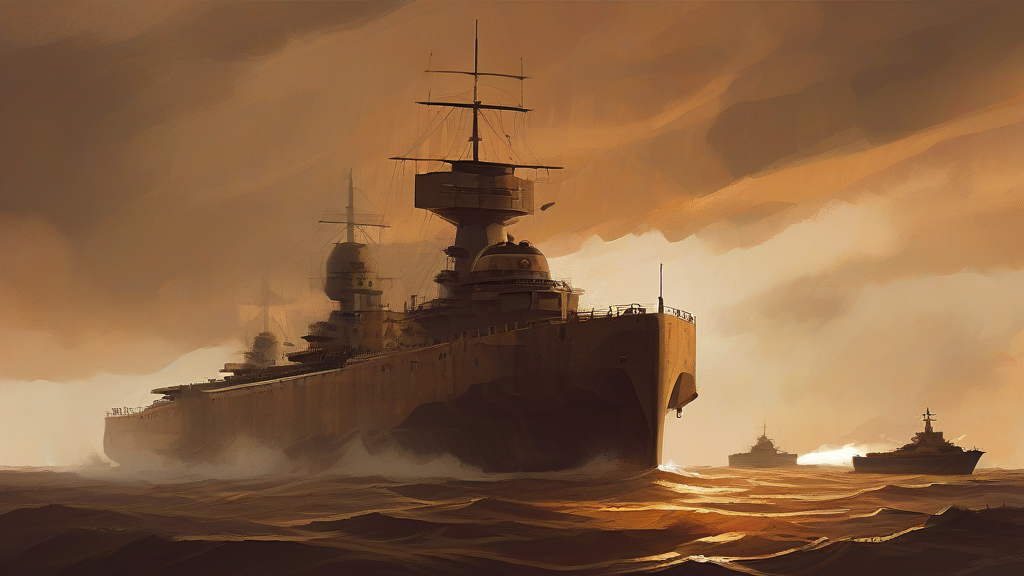
What does dreadnaught mean?
Dreadnaught is a variant spelling of dreadnought, a noun with two related senses. Historically, it denotes the revolutionary class of early twentieth-century battleships — beginning with HMS Dreadnought of 1906 — whose armament consisted entirely of large-calibre guns, rendering earlier warships obsolete. By extension, the word describes a person or thing that is fearless, powerful, and seemingly unstoppable. The name derives from the English phrase meaning one who dreads nothing, combining 'dread' with the archaic 'aught' (nothing). Today the standard spelling is dreadnought, and 'dreadnaught' appears mainly in older texts or as a stylistic variant. Whether evoking iron-hulled giants of the pre–First World War arms race or a bold, dauntless individual, the word carries connotations of overwhelming strength and invincibility.
A battleship of the type introduced by HMS Dreadnought (1906), carrying an armament exclusively of large-calibre guns.
"Naval historians trace the arms race to the launch of the first dreadnaught."
A fearless and formidable person or thing.
"In the ring he was a dreadnaught who feared no opponent."
Regular plural; used chiefly for the battleships.
"Ten new dreadnaughts were laid down before the war."
The word literally means 'fear nothing' — a name so bold it was given to an entire generation of battleships that made every older warship obsolete overnight.
Reviewed by Deb Chak, Editor. AI-assisted content curated by RJS Tech Solutions LLP.
Etymology of dreadnaught
Dreadnaught comes from the English phrase dread nought, literally 'fear nothing', formed from 'dread' plus the archaic pronoun 'nought' (nothing); the spelling with '-aught' reflects this older form of 'nought'. It was used as a name for fearless people from at least the 16th century before being famously applied to HMS Dreadnought in 1906, after which it became the generic term for that class of battleship. Related words sharing the root include 'dread' itself and, more distantly, words expressing fearlessness such as 'dauntless'.
How dreadnaught is actually used
This spelling is now considered a less common variant of 'dreadnought'; modern usage strongly prefers the standard spelling in both British and American English.
Easily confused with dreadnaught
Dreadnaught is simply an older or variant spelling; dreadnought is now the standard form for both the battleship sense and the fearless-person sense.