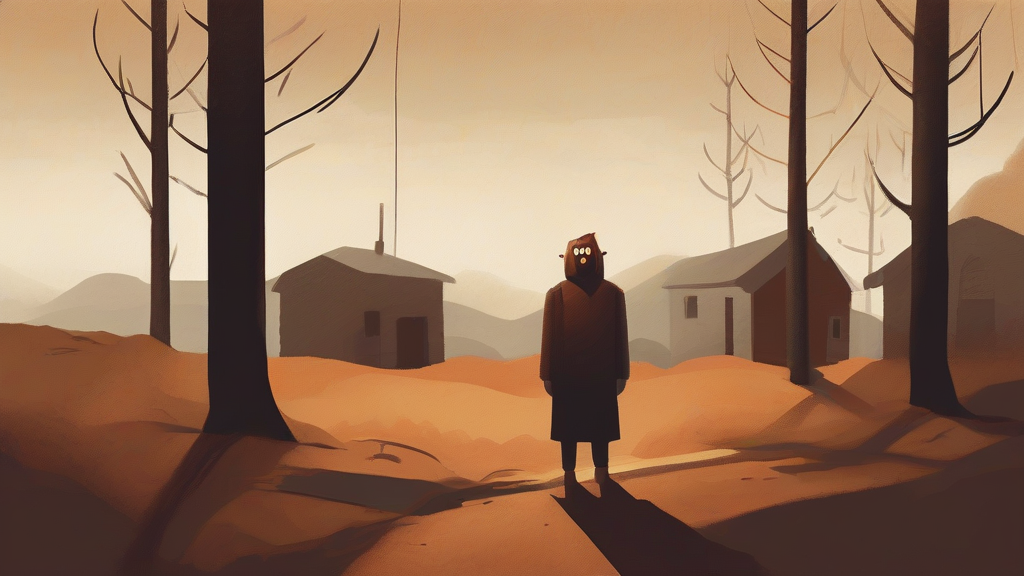
What does drearihead mean?
Drearihead is a rare and largely archaic English noun meaning dreariness — the quality or condition of being gloomy, bleak, or depressingly dull. It is built from the adjective 'drear' (a poetic short form of 'dreary') combined with the old noun-forming suffix '-head', the same element seen in words such as 'Godhead' and 'maidenhead'. Like those formations, it belongs chiefly to older or deliberately literary registers of English, and a contemporary writer reaching for it is usually making a conscious stylistic choice rather than following common usage. A sentence such as 'a settled drearihead fell over the village' conveys not merely bad weather but an atmosphere of sustained, almost tangible gloom. Though seldom encountered today, the word offers a vivid example of how English once formed abstract nouns, and it can lend prose a distinctly archaic or poetic colour when used with intention.
nounDreariness; the quality or state of being drear — gloom, dullness, or bleakness. An archaic or literary formation now rarely encountered.
- The state or quality of being dreary; gloom, dullness, or bleakness.
"The long grey winter wrapped the moor in a drearihead that seemed to seep into the very stones of the farmhouse."
"Rain hammered on the windows for a week, and a settled drearihead fell over the village."
"He wrote to escape the drearihead of his office routine, filling his evenings with music and travel."
Rarely pluralised; the word typically appears as an uncountable mass noun denoting a quality or atmosphere.
"Each of his novels trades in the same dreariheads of provincial life."
Drearihead borrows the same old suffix found in 'Godhead' — English once built abstractions like this the way we now use '-ness'.
Reviewed by Deb Chak, Editor. AI-assisted content curated by RJS Tech Solutions LLP.
Etymology of drearihead
Drearihead combines 'drear', a poetic variant of 'dreary', with the Old English-derived suffix '-head', which forms abstract nouns (as in Godhead). The root behind 'dreary' traces back through Middle English 'drei'/'dregh' meaning weary or tedious, ultimately connected to Old English words denoting dryness or hardship, cognate with Germanic terms related to dryness and endurance. The '-head' suffix itself comes from Old English '-hǣd' ('state, condition'), the ancestor of the modern '-hood' as in childhood. Drearihead has never been common and survives mainly as a literary curiosity alongside its more durable rival 'drearness' and, above all, the standard modern 'dreariness'.
How drearihead is actually used
Archaic and literary; modern writers would normally choose 'dreary' or 'dreariness'. The word carries a heavy, melancholy connotation and may be used deliberately for archaic or poetic flavour.
Easily confused with drearihead
Drearihead is an archaic synonym for the same quality; dreariness is the ordinary modern word in everyday use.