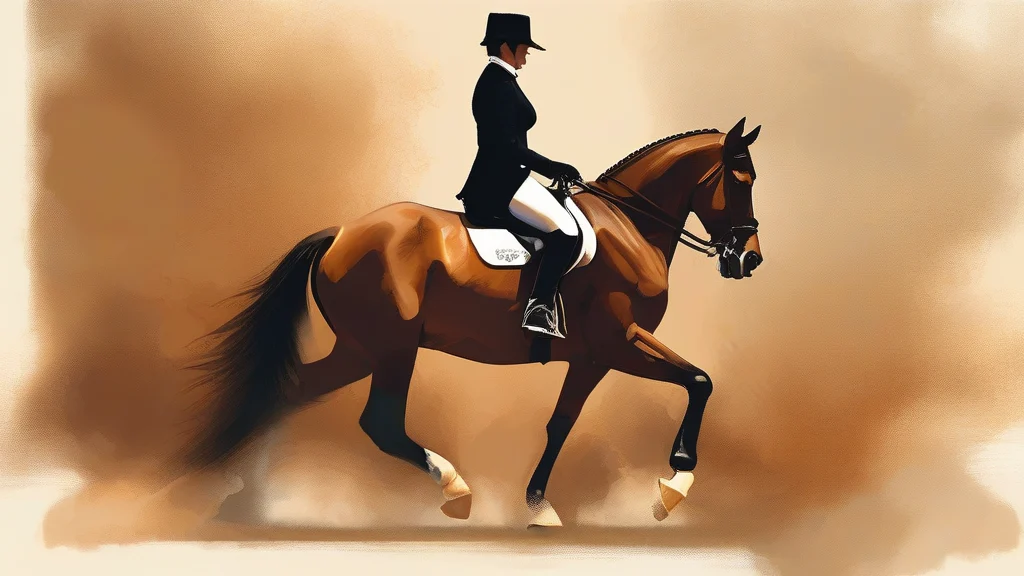
What does dressage mean?
Dressage is a form of horse training and a competitive equestrian discipline in which a horse is taught to carry out precise, controlled movements in response to nearly invisible signals from its rider. Often described as ballet on horseback, it emphasizes balance, suppleness, obedience, and the harmonious partnership between horse and rider rather than speed or jumping ability. In competition, pairs perform predetermined sequences of movements — called tests — before judges who score them on accuracy, grace, and fluidity. Dressage has deep roots in classical European horsemanship and became an Olympic sport in 1912, remaining one of the few Olympic events where men and women compete directly against each other. The word carries connotations of elegance, discipline, and refinement, and it retains its French pronunciation in English. Beyond elite sport, dressage principles underpin much of general riding training, since they develop a horse's responsiveness, athleticism, and willingness to work with its handler.
The art of training a horse to perform precise, controlled movements in response to subtle cues from the rider.
"Her dedication to dressage earned her a place on the national team."
Usually treated as uncountable; occasionally used countably for individual performances or tests.
A competitive equestrian event in which riders guide their horses through a series of judged movements demonstrating obedience, flexibility, and harmony.
"He won gold medals in both showjumping and dressage."
In this sense it may be used countably, as in 'three dressages' referring to three competitive rides, though this usage is relatively rare.
Dressage is typically uncountable when referring to the discipline as a whole. A plural form exists but is uncommon, generally used to refer to multiple individual competitive tests or rides.
"She rode two flawless dressages over the weekend."
Dressage is often called 'horse ballet' — and it's been an Olympic sport since 1912, making it one of the oldest Olympic equestrian events.
Reviewed by Deb Chak, Editor. AI-assisted content curated by RJS Tech Solutions LLP.
Etymology of dressage
Dressage comes from French dresser, meaning 'to train' or 'to drill', which itself derives from the Latin directus, meaning 'straight' or 'direct'. The term was adopted into English in the 20th century, though the practice it describes dates back centuries to European cavalry training traditions. Related English words sharing this Latin root include address, redress, and correct.
How dressage is actually used
The word is uncountable when referring to the practice as a whole ('she studies dressage') but can be used countably when referring to individual tests or routines. It retains its French pronunciation in English, with stress on the second syllable and a soft 's' sound. It is a formal, technical term associated primarily with equestrian sports.
Easily confused with dressage
Dressing refers to sauce for food, bandaging a wound, or putting on clothes, whereas dressage is the discipline of training horses in precise movements.