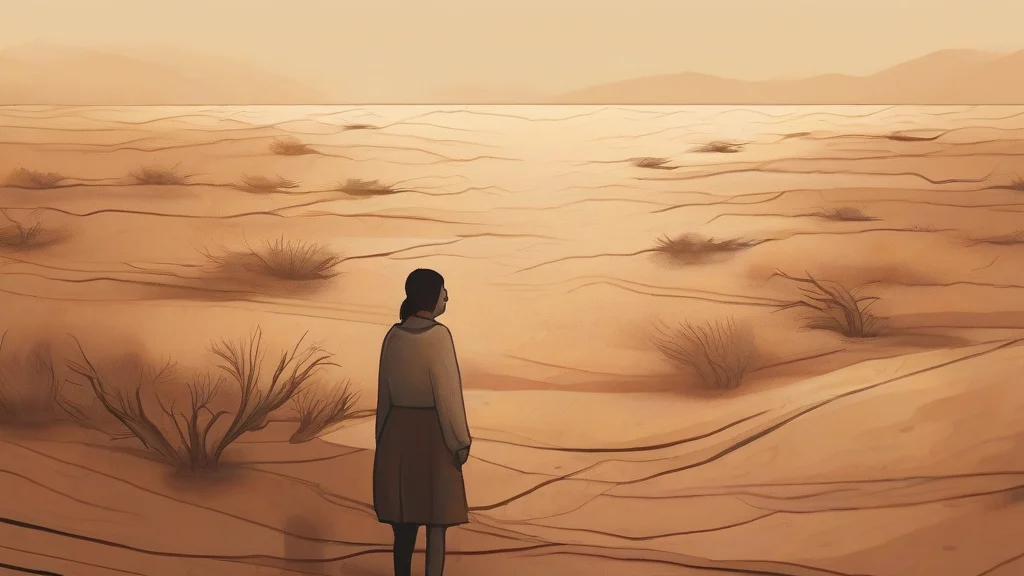
What does dry mean?
Dry is one of English's most versatile everyday words. At its most literal, it describes something free from moisture — a dry towel, dry skin, a dry road after rain. It extends naturally to climate and weather, as in a dry season or a dry spell with little rainfall. Beyond the physical, dry carries rich figurative weight: 'dry humor' or 'a dry remark' denotes understated wit delivered without a smile, while describing a lecture or report as dry signals that it is dull and lifeless. The word also appears in fixed phrases such as 'a dry run' (a rehearsal), 'high and dry' (left stranded), and 'cut and dried' (settled and decided). As a verb, dry means to remove moisture or to become dry, as when clothes dry on a line. With its Old English roots and remarkable stability across centuries, dry remains a precise, flexible word essential to both practical description and subtle social commentary.
Free from moisture or liquid; not wet.
"Make sure the surface is dry before you paint it."
(Of humor or wit) understated and delivered without emotion or expression.
"She has a wonderfully dry sense of humor that takes people a moment to catch."
This figurative sense is well established and generally complimentary, suggesting sophistication rather than coldness.
To remove moisture from something, or to become free of moisture.
"Leave the dishes to dry on the rack."
A prohibitionist or person who advocates abstinence from alcohol (chiefly US, historical).
"The drys won the vote and the county went alcohol-free in 1915."
This noun sense is largely historical, associated with the temperance movement and Prohibition-era America.
Dry is one of the oldest words in English — it has barely changed in sound or meaning since before Shakespeare, tracing back over a thousand years.
Reviewed by Deb Chak, Editor. AI-assisted content curated by RJS Tech Solutions LLP.
Etymology of dry
Dry comes from the Old English drȳge, meaning free from moisture, which itself derives from Proto-Germanic *draugiz. It shares a deep Germanic root with words like drought and drain, all connected to the idea of dryness and drawing off liquid. Cognates appear in other Germanic languages, such as Dutch droog and German trocken. The verb form developed from the adjective through Middle English, and the word has remained remarkably stable in form and meaning throughout its recorded history.
Related word forms
How dry is actually used
Dry is a common, neutral word in all registers. As an adjective it covers both literal absence of water and figurative senses: 'dry humor' implies understated wit delivered without emotion, while calling a book 'dry' suggests it is tedious. In British English, 'a dry county' or 'going dry' refers to abstaining from alcohol. Both 'dryer' and 'drier' are accepted spellings of the noun form.
Easily confused with dry
Arid specifically describes land or climates that are extremely dry and barren, while dry is the general everyday term for anything free of moisture.