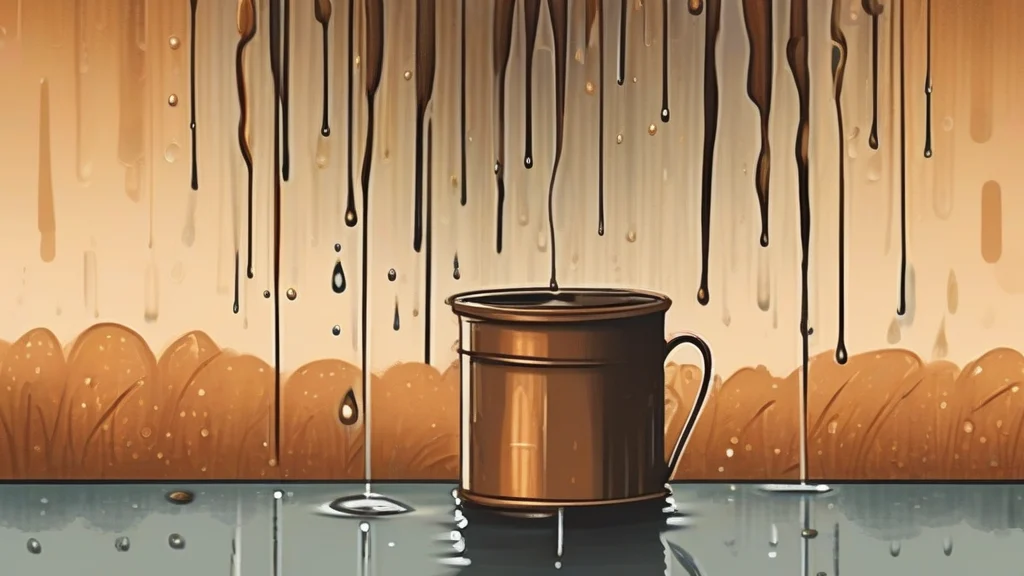
What does drip mean?
Drip is one of those compact English words that works equally well as a verb and a noun. As a verb, it describes liquid falling or escaping in small, individual drops: rainwater drips from gutters, a wound drips blood, and a speaker's tone can drip with sarcasm or insincerity. As a noun, it names both a single falling drop and the persistent patter of drops, as well as a device used in hospitals to feed fluids or medication into a vein — patients are commonly said to be 'on a drip'. The word also carries two informal senses: chiefly in British English, calling someone a drip means they are weak, dull, or ineffectual; more recently, in American slang popularized through hip-hop, drip refers to fashionable personal style. Derived forms such as dripping, dripper, and drip-dry extend its usefulness across everyday and technical contexts.
To fall or let fall in small drops; to leak or shed liquid gradually.
"Condensation dripped from the cold windowpane."
Often used figuratively to suggest saturation or excess: 'a voice dripping with honey'.
A drop of liquid, the sound of drops falling, or a device for administering fluid drop by drop.
"He was connected to a saline drip overnight."
In British informal speech, a 'drip' is a feeble or boring person; in recent American slang it means stylish flair.
Regular plural; often used for repeated sounds of falling liquid or individual drops.
"We could hear the soft drips of melting snow outside the tent."
Before modern slang gave 'drip' its swagger as a compliment about stylish clothes, it was the humble sound of a leaky tap — a word that went from plumbing to fashion in barely a decade.
Reviewed by Deb Chak, Editor. AI-assisted content curated by RJS Tech Solutions LLP.
Etymology of drip
Drip is a native Germanic word, appearing in Middle English as a frequentative form related to the verb 'drop', with cognates in other Germanic languages such as Danish 'drippe'. It has been part of English since at least the medieval period, describing the slow, repeated fall of liquid in small drops. Over centuries it developed both literal senses relating to water and bodily fluids and figurative uses, including its application to medical apparatus and, much later, to personality and fashion.
Related word forms
How drip is actually used
The verb is common in both literal and figurative use ('the walls were dripping with moisture'; 'his voice dripped with sarcasm'). The informal British and Irish sense meaning a boring person dates from the mid-20th century. The slang sense meaning stylish flair is recent American usage, popularized by hip-hop culture from around 2010 onward.
Easily confused with drip
Dribble suggests liquid flowing in a thin unsteady stream or saliva at the mouth, while drip refers to discrete drops falling one by one.