
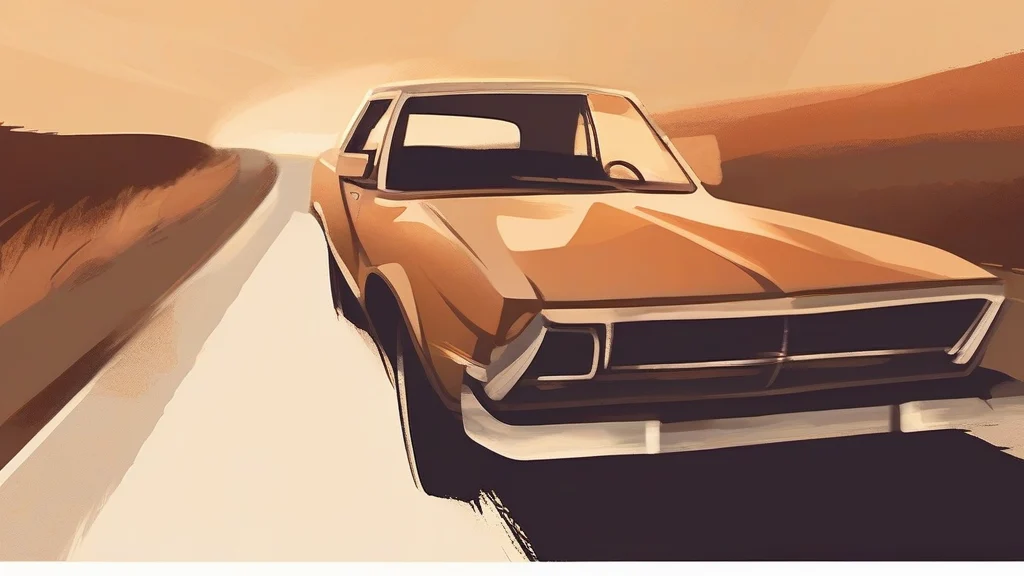
What does drive mean?
Drive is one of English's most versatile words, functioning as both verb and noun across remarkably different domains. Most familiarly, it means to operate a car or other vehicle — to sit behind the wheel and control its movement. Beyond transport, it describes any act of propelling, compelling, or motivating: cattle can be driven across country, a machine can be driven by an engine, and a person can be driven to despair or to greatness. As a noun, drive names a journey by car, the transmission of power within machinery (as in four-wheel drive), a data-storage device in computing, a forceful stroke in sports such as golf or cricket, and — perhaps most powerfully — an inner hunger or determination. This psychological sense gives us phrases like "a driven individual," carrying strongly positive connotations of energy and ambition. Rooted in Old English drīfan, meaning to force to move, the word has expanded steadily alongside human technology and ambition.
To operate and direct the course of a vehicle; to force or compel something to move or progress; to supply the motive power for a machine.
"He drove through the night to reach the coast by dawn."
A journey in a vehicle; a strong innate urge, ambition, or determination; a mechanism transmitting power in machinery; a storage device in computing; a forceful stroke in sports.
"We took a scenic drive along the coastal road."
The plural "drives" most commonly refers to multiple journeys by vehicle or to storage devices in computing contexts.
"Both hard drives failed within the same week."
The word 'drive' once referred almost entirely to forcing animals to move — only with the arrival of the automobile did it become the everyday word for steering a car.
Reviewed by Deb Chak, Editor. AI-assisted content curated by RJS Tech Solutions LLP.
Etymology of drive
Drive comes from Old English drīfan, meaning to force or impel something to move, which shares a common Germanic ancestor with related words such as drift. Cognates appear across Germanic languages: German treiben and Dutch drijven carry similar meanings of driving or floating. Originally applied largely to herding animals, the word's meaning broadened over centuries to cover propulsion of vehicles, machinery, and even abstract motivation, making it one of the most semantically expansive verbs in modern English.
Related word forms
How drive is actually used
In British English, "drive" typically implies being at the controls of a car, while American English uses it similarly but also extends it to golf and other sports. The past tense is "drove" and the past participle is "driven" — never say "have drove." As a noun for motivation, "drive" carries a positive, energetic connotation.
Easily confused with drive
"Drive" means to operate or propel something, while "drivel" is nonsense or foolish talk.
"Drive" involves operating a vehicle or pushing forward; "diver" is a person who swims underwater or plunges headfirst.