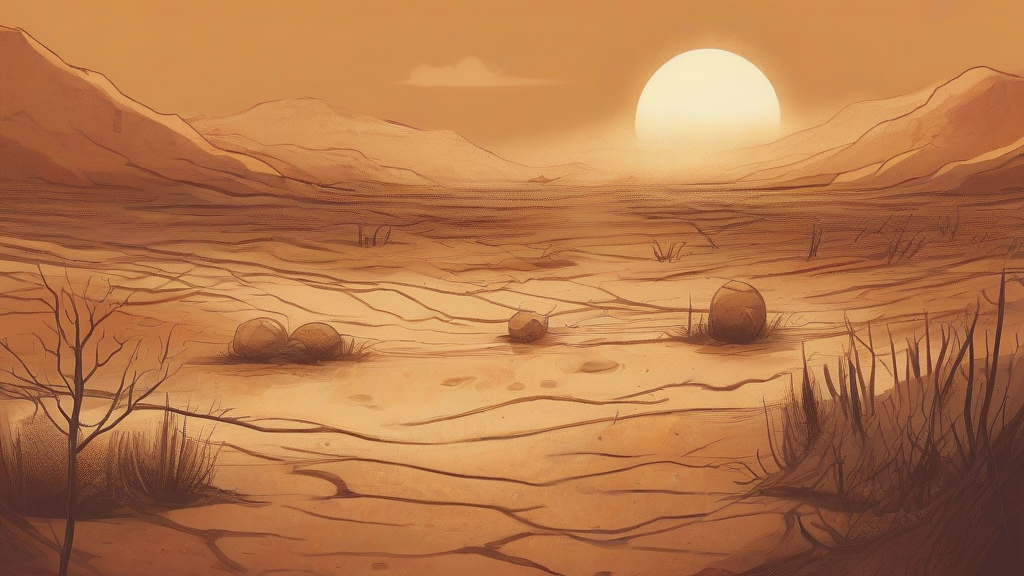
What does drought mean?
A drought is a prolonged period during which a region receives significantly less rainfall than normal, resulting in a shortage of water that can devastate agriculture, deplete reservoirs, threaten wildlife, and disrupt human communities. Unlike a single dry week, a drought implies duration and severity — a sustained deficit with real consequences. The word is also used figuratively to describe any extended scarcity, as in "a drought of good news" or "a creative drought." It appears constantly in journalism, environmental reporting, and policy discussions about climate change, making it essential vocabulary for anyone following current events. Grammatically, "drought" functions as a countable noun with the plural "droughts," and it combines readily with adjectives such as "severe," "prolonged," and "record-breaking," as well as in compounds like "drought-resistant." Though spelled with a silent "gh" inherited from Middle English, the word is pronounced with a single syllable: /draʊt/.
A prolonged period of abnormally low rainfall resulting in a serious shortage of water.
"The drought forced the city to impose strict water rationing for the first time in twenty years."
Often modified by adjectives indicating severity or duration: severe, extreme, prolonged, historic.
An extended scarcity or lack of something desirable or necessary (figurative).
"The team endured a goal-scoring drought that stretched across eight matches."
The plural is used when referring to multiple distinct occurrences of drought, often in historical, comparative, or regional discussions.
"Historical records show that severe droughts struck the region roughly once a generation."
Despite its silent 'gh,' "drought" once rhymed with "brought" — Middle English speakers pronounced every letter.
Reviewed by Deb Chak, Editor. AI-assisted content curated by RJS Tech Solutions LLP.
Etymology of drought
"Drought" derives from Old English "drūgað," meaning dryness or a dry place, formed from the adjective "drȳge" (dry) plus a noun-forming suffix — making it a genuinely Germanic word rather than a Latin or French borrowing. In Middle English it appeared in forms such as "droghte," famously opening Chaucer's Canterbury Tales with reference to the April rains ending March's drought. The modern spelling reflects the addition of "-ght" under the influence of words like "night" and "might," while the pronunciation was later shortened to a single syllable. A variant form, "drouth," arose by analogy with words like "length" and survives chiefly in American dialectal use.
How drought is actually used
"Drought" is standard across all registers and regions; it is an uncountable noun when referring to the condition in general but takes the plural "droughts" when referring to individual occurrences. The figurative sense (a dearth of anything) is well established in journalism and everyday speech. The variant spelling "drouth" survives mainly in American dialectal use.
Easily confused with drought
"Drouth" is an archaic or chiefly American variant spelling and pronunciation of the same word "drought," not a different word.