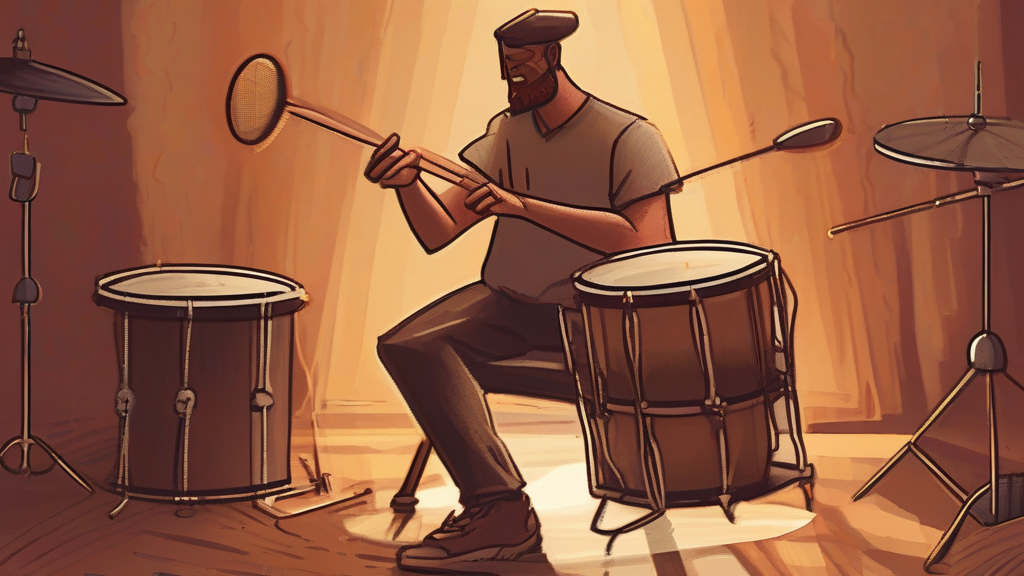
What does drumbeater mean?
A drumbeater is, literally, someone who plays or beats a drum, but in contemporary English the word is used far more often in a figurative sense: an energetic, vocal promoter of a cause, candidate, product, or idea. Calling someone a drumbeater suggests relentless enthusiasm and noisy advocacy — the image being that of a drummer rousing attention and rallying support. The term frequently carries a slightly skeptical or ironic edge, implying hype rather than measured argument, as in 'the media's chief drumbeaters for the war.' It appears most often in journalism and political commentary, where writers describe lobbyists, pundits, advertisers, or campaigners as drumbeaters for particular agendas. The literal sense survives mainly in historical accounts of military bands, processions, and ceremonies, where drummers kept time and signaled commands. Related forms include drumbeat, meaning both the rhythmic striking of a drum and, metaphorically, a persistent stream of messaging or pressure. The word is standard in both British and American English.
A person who beats a drum, especially in a band, procession, or military context.
"The young drumbeater kept flawless time at the head of the parade."
This literal sense is comparatively rare today, surviving mostly in historical writing.
An energetic promoter or vocal advocate of a cause, person, product, or idea.
"She became one of the leading drumbeaters for electoral reform in the region."
Often used with mild irony or criticism, implying noisy promotion over substantive argument.
Standard plural; common in journalistic phrases such as 'drumbeaters for reform.'
"The bill found its drumbeaters on both sides of the aisle."
Long before 'influencer' existed, the drumbeater did the job — loudly.
Reviewed by Deb Chak, Editor. AI-assisted content curated by RJS Tech Solutions LLP.
Etymology of drumbeater
The word is a straightforward English compound of 'drum' and 'beater,' formed within English rather than borrowed from another language. 'Drum' entered English in the sixteenth century, likely of imitative (onomatopoeic) origin, possibly influenced by Middle Dutch or Low German 'trom,' while 'beat' derives from Old English 'bēatan,' meaning to strike, from the Germanic root underlying words such as 'bat' and 'battle' (the latter ultimately from Latin 'battuere,' to beat). The literal compound appeared first for military and ceremonial drummers, and the figurative sense of an enthusiastic promoter developed later, by analogy with the drummer's role in rousing and rallying crowds.
Related word forms
How drumbeater is actually used
The literal sense (someone playing a drum) is now relatively rare outside historical or ceremonial contexts; in modern usage the word almost always carries the figurative sense of a zealous promoter. It often carries a mildly critical or ironic connotation, suggesting someone who hypes a cause noisily rather than arguing its merits on substance.
Easily confused with drumbeater
A drumstick is the stick used to strike a drum, whereas a drumbeater is the person doing the striking or, figuratively, an enthusiastic promoter.