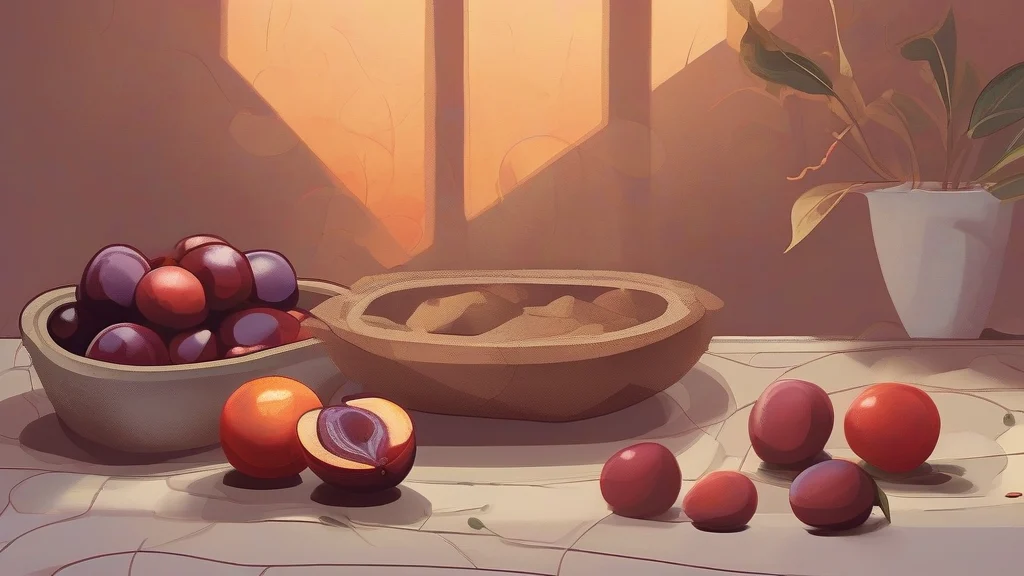
What does drupaceous mean?
Drupaceous is a technical adjective used chiefly in botany and horticulture to describe plants or fruits that bear or resemble drupes. A drupe is the botanical category of so-called stone fruits — fruits such as peaches, plums, cherries, olives, and almonds whose outer layer is soft and fleshy while their inner layer hardens into a stony case around the seed. Calling something drupaceous signals this characteristic structure: edible pulp surrounding a single hard-shelled kernel. The word appears mainly in scientific descriptions, agricultural writing, and field guides, where precision about fruit type matters; a gardener might note that a shrub produces drupaceous fruit to distinguish it from one bearing berries or pomes (apples and pears). Outside these contexts it is rare and can sound overly formal. For anyone interested in plant science or pomology, however, it offers an exact, economical way to group together some of the world's most familiar and beloved orchard fruits under a single descriptive label.
adjectiveRelating to, resembling, or producing drupes — fruits with fleshy outer layers surrounding a hard stone that encloses a seed, such as plums, cherries, and olives.
- Relating to or resembling a drupe (a fruit with a fleshy exterior and a hard stone enclosing a seed), as used in botanical description.
"The orchard's most valuable section was devoted to drupaceous crops like apricots and nectarines."
"Botanists classify the peach as a classic drupaceous fruit, with its succulent flesh wrapped around a deeply furrowed pit."
"The herbarium notes described the specimen as bearing small, darkly pigmented, drupaceous berries."
Reviewed by Deb Chak, Editor. AI-assisted content curated by RJS Tech Solutions LLP.
Etymology of drupaceous
Drupaceous derives from the Latin noun 'drupa', meaning an overripe olive, which itself was borrowed from the Greek 'druppa', referring to a ripened olive with its flesh softened. The Latin word was combined with the adjectival suffix '-aceous' (from '-aceus'), commonly used in scientific Latin to form adjectives of resemblance or relationship. The term entered English as part of the vocabulary of scientific botany, alongside its simpler cousin 'drupe'.
How drupaceous is actually used
A technical term confined almost entirely to botany and horticulture; it would sound pedantic in general conversation, where 'stone fruit' is preferred.
Easily confused with drupaceous
Herbaceous describes non-woody plants that die back each year, while drupaceous specifically refers to stone fruits like plums and cherries; the two rhyme and share a suffix but are unrelated in meaning.