
What does dryer mean?
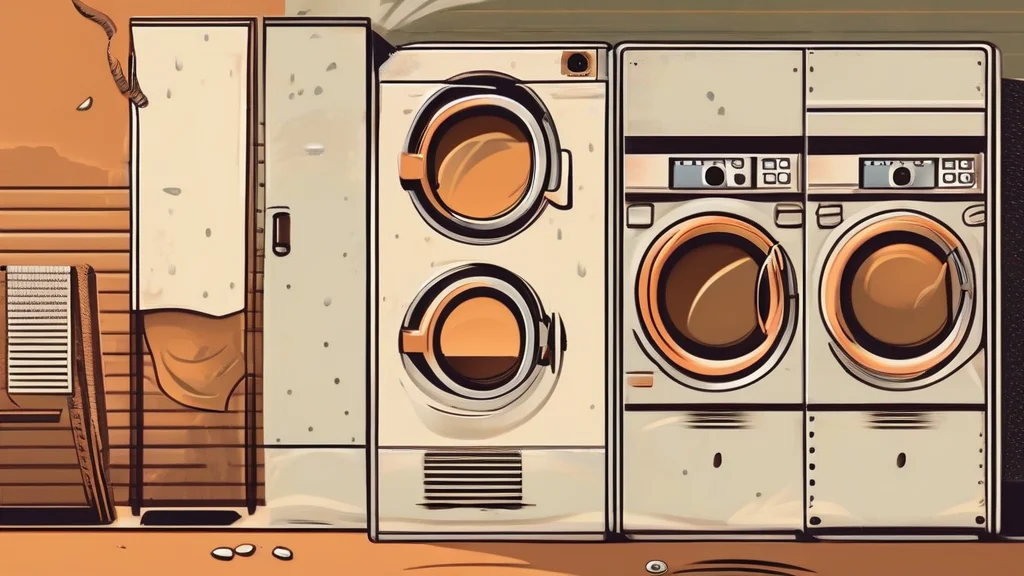
A dryer is a machine designed to remove moisture from objects, most commonly from freshly washed clothing. In households across much of the English-speaking world, the term refers to the appliance — often paired with a washing machine — that tumbles wet laundry in heated air until it is dry enough to wear or store. The word also covers smaller devices such as hair dryers and hand dryers, as well as larger industrial machines used to dehydrate grain, lumber, and other materials. In American English, 'dryer' can also denote a substance added to paint or varnish to speed up drying, though this sense overlaps with the alternative spelling 'drier'. The noun is firmly rooted in everyday domestic life, evoking routine chores rather than formal or technical registers, and its near-homophone relationship with 'drier', the comparative of 'dry', occasionally causes spelling confusion among writers.
An appliance or machine that removes moisture, especially one that dries washed clothes by tumbling them in warm air.
"He loaded the wet sheets into the dryer and set it to high heat."
Often preceded by a specifying noun: hair dryer, hand dryer, tumble dryer.
A substance added to paint, varnish, or ink to accelerate the drying process; more commonly spelled 'drier'.
"The painter added a small amount of dryer to speed up the curing of the oil-based varnish."
This sense is chiefly technical and largely confined to industrial or trade usage; 'drier' is the preferred spelling.
Standard regular plural; used when referring to multiple machines or devices.
"The laundromat had twelve washers and eight dryers."
Before electric dryers, people dried clothes on lines or wrung them by hand — a chore so universal it gave rise to an entire appliance category now found in roughly 80% of American homes.
Reviewed by Deb Chak, Editor. AI-assisted content curated by RJS Tech Solutions LLP.
Etymology of dryer
The word 'dryer' derives from the verb 'to dry,' which comes from Old English 'drȳge,' meaning free from moisture. This root is related to the Proto-Germanic '*draugiz' and has cognates in Dutch 'droog' and German 'trüge' (though the latter is not directly cognate). As mechanical appliances emerged during the Industrial Revolution and became widespread in the twentieth century, 'dryer' came to name the machines themselves. It should not be confused with 'drier,' the comparative form of the adjective 'dry,' although both words share the same underlying root and are sometimes spelled interchangeably.
Related word forms
How dryer is actually used
Commonly used in domestic and everyday contexts. In British English, 'tumble dryer' is the more precise term for the laundry appliance, while 'dryer' alone is understood but slightly less specific. The spelling 'dryer' is standard for the noun; 'drier' is preferred for the adjective's comparative form, though both spellings appear for either word in informal use.
Easily confused with dryer
'Drier' is the comparative form of the adjective 'dry' (meaning less wet), while 'dryer' is typically the noun for the drying machine — though both spellings are used interchangeably in some regions.