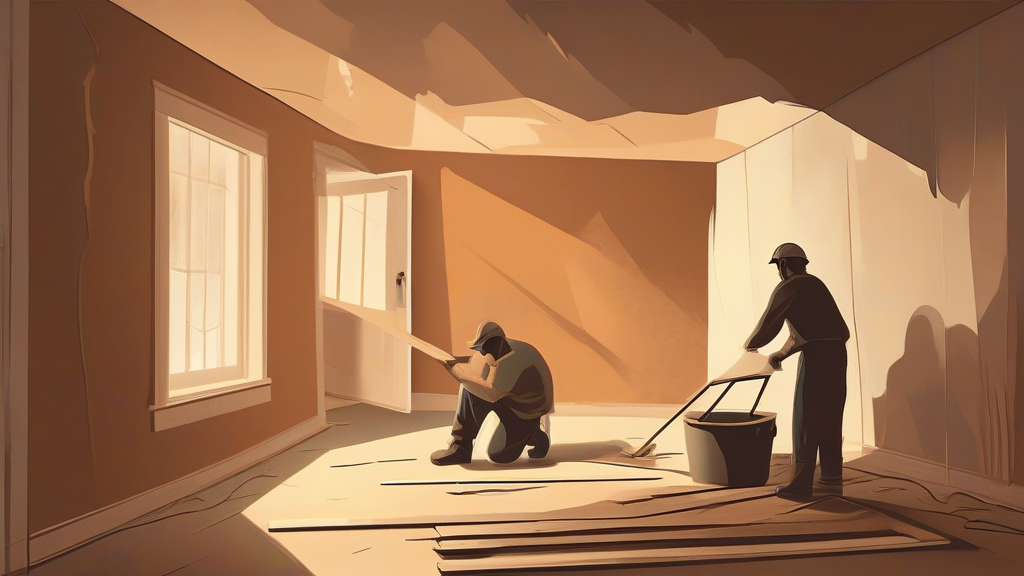
What does drywalling mean?
Drywalling is the process of constructing interior walls and ceilings by fixing large panels of drywall — also known as gypsum board, wallboard, or plasterboard — to a building's timber or metal framework, then sealing and smoothing the joints with tape and joint compound. Unlike traditional plastering, which builds up surfaces from wet material applied in coats, drywalling uses factory-made boards that go up quickly and cleanly, which is why the method became dominant in North American construction after the mid-twentieth century. The word functions as the present participle and gerund of the verb 'to drywall', so it appears both in continuous verb forms ('they are drywalling the garage') and as a noun-like label for the activity itself ('the drywalling took three days'). Its register is practical and everyday, heard most often among builders, contractors, and home renovators. Outside North America, speakers typically say 'plasterboarding' or simply 'boarding' instead, making drywalling a distinctly regional term tied to North American building vocabulary.
verb (present participle/gerund)The act of fitting and finishing drywall (large panels of gypsum board) to form interior walls and ceilings in a building.
- Fitting sheets of gypsum drywall to timber or metal studs to construct interior walls and ceilings.
- (Informally) the trade or task performed by a drywaller.
"They spent the weekend drywalling the new extension before the painters arrived."
"The contractors finished drywalling the basement by Thursday afternoon."
"He learned drywalling on the job, taping seams until his technique was flawless."
Drywalling replaced wet plaster so completely after World War II that an entire room can now be 'walled' in an afternoon — no drying time required.
Reviewed by Deb Chak, Editor. AI-assisted content curated by RJS Tech Solutions LLP.
Etymology of drywalling
Drywalling derives from the compound 'drywall', formed transparently from the native English words 'dry' (Old English drȳge) and 'wall' (Old English weall, borrowed from Latin vallum, meaning rampart). The term arose in early twentieth-century American English to distinguish the new gypsum-panel method from wet plasterwork, and the verb 'to drywall' followed naturally once the product became widespread in mid-century construction. Its cognates are less linguistic than material: British 'plasterboard' names the same substance through its plaster connection, while words like 'rampart' share the deeper Latin root of 'wall'.
Related word forms
How drywalling is actually used
Primarily North American usage; in British English the equivalent activity is usually called 'plasterboarding' or 'boarding', since 'drywall' itself is chiefly a North American term. The word is informal-to-neutral register, common in construction and DIY contexts rather than formal writing.
Easily confused with drywalling
Plastering applies wet paste to surfaces in multiple coats, whereas drywalling fixes pre-made gypsum panels to a frame and finishes the joints.