
What does duck mean?
Duck is a common English word functioning as both a noun and a verb. As a noun, it denotes a familiar waterbird with a flat bill, webbed feet, and waterproof feathers, found across much of the world, and by extension the meat of this bird, which is considered rich and flavoursome. As a verb, duck means to lower the head or body abruptly to avoid a blow, a flying object, or detection, as when one ducks under a branch. The word also carries well-established figurative uses: to duck a question or duty is to evade it, while a person who is exposed to criticism without protection may be called a sitting duck. In cricket, a batter who scores no runs is said to have made a duck. The word appears in numerous idioms, including like a duck to water and lame duck, reflecting how deeply embedded it is in everyday English across British and American usage alike.
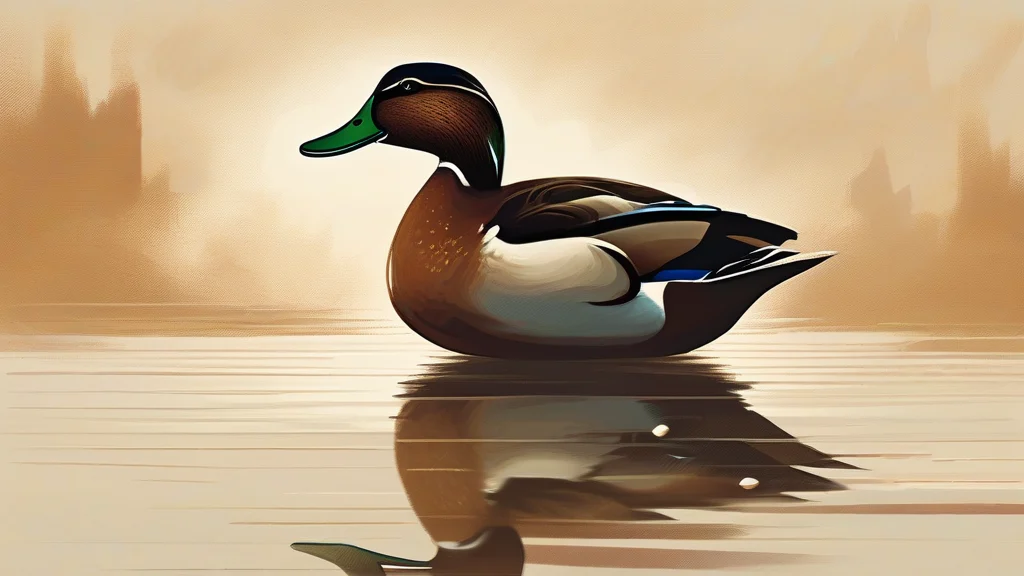
A waterbird of the family Anatidae, typically having a flat bill, short legs, webbed feet, and waterproof plumage; also, the flesh of this bird used as food.
"A mallard duck glided across the surface of the lake at dawn."
To lower the head or body suddenly in order to avoid a blow, an object, or observation; to evade or sidestep a duty, question, or obligation.
"She had to duck quickly as the ball flew towards her face."
When applied metaphorically to duties or questions, 'duck' carries a slightly negative connotation, implying avoidance or evasion rather than legitimate deferral.
The standard plural is 'ducks'; however, when referring to the edible meat or to ducks as an undifferentiated group, the singular or collective form may be used instead ('roast duck', 'a flock of duck').
"Several wild ducks landed on the riverbank just after sunrise."
The phrase 'a sitting duck' comes from hunting: a duck resting on water can't take flight quickly, making it the easiest target of all.
Reviewed by Deb Chak, Editor. AI-assisted content curated by RJS Tech Solutions LLP.
Etymology of duck
The noun 'duck' comes from Old English 'duce', meaning a diver or ducker, derived from the Old English verb 'ducan', meaning 'to dive'. This makes the bird's name literally a description of its habit of diving underwater for food. The verb 'to duck', meaning to lower oneself quickly, developed from the same root, preserving the original diving sense in a more general form. Cognates appear in other Germanic languages, such as Middle Dutch 'duken' (to dive), reflecting a shared Germanic origin rather than Latin or Greek roots.
Related word forms
How duck is actually used
As a term of endearment ('all right, duck?'), the word is chiefly British and regionally concentrated in the English Midlands, particularly around Nottingham and Derby; it is informal and friendly. In American English, 'duck' as a verb is very common in both literal and figurative senses, while the cricket sense is largely confined to Commonwealth countries. The plural of the bird is simply 'ducks', but when referring to ducks as a collective group on water, the unmarked plural is also used ('a flock of ducks').
Easily confused with duck
A dock is a structure where ships are moored or an enclosed area of water, whereas a duck is a waterbird — the two differ in both vowel sound and meaning.