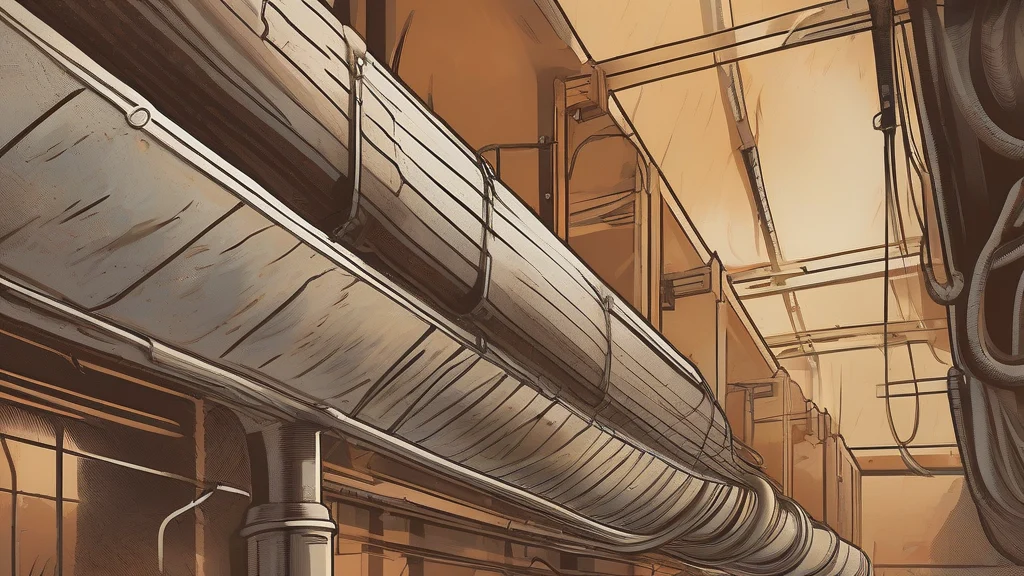
What does ducting mean?
Ducting is the collective term for the tubes, channels, or pipework that carry air, gases, fumes, liquids, or cables from one place to another within a building or machine. Most familiar in the context of heating, ventilation, and air-conditioning systems, ducting is usually made from galvanised steel, aluminium, or flexible plastic, and is concealed above ceilings, behind walls, or beneath floors so that conditioned air can be distributed invisibly throughout a space. The word also denotes the raw material or sections used to build these channels — a contractor might order several metres of flexible ducting, for example. It is chiefly a technical register term, common in construction, engineering, and electrical trades, though it appears in everyday speech whenever home renovation or airflow problems come up. Derived ultimately from the Latin verb ducere, meaning 'to lead', the word neatly describes its own function: ducting leads whatever flows through it to its intended destination.
A system of tubes or channels used to convey air, gas, liquid, or cables, especially within a building.
"The renovation involved replacing all the old ducting in the basement."
Usually uncountable when referring to the system or material generally.
The material or prefabricated sections from which ducts are constructed.
"We bought three metres of flexible ducting at the hardware store."
Rarely used; 'ducting' is normally treated as an uncountable mass noun. A plural form exists only when referring to distinct types or individual pieces of ducting, and even then 'sections of ducting' or 'pieces of ducting' is more natural.
"The catalogue lists various flexible ductings suitable for extractor fans."
The word traces back to Latin ducere — 'to lead' — so every piece of ducting in your walls is literally doing its name's job: leading air where it needs to go.
Reviewed by Deb Chak, Editor. AI-assisted content curated by RJS Tech Solutions LLP.
Etymology of ducting
Ducting derives from the noun 'duct', which entered English in the mid-17th century from Latin ductus, meaning 'a leading' or 'a channel', itself from the verb ducere, 'to lead'. The same Latin root gives English a family of words including conductor, aqueduct, and viaduct, all built around the idea of guiding something along a path. The suffixed form 'ducting' arose as an agentive or material noun, following the pattern of words like 'piping' and 'wiring', to describe both the system of ducts and the substance from which they are made.
Related word forms
How ducting is actually used
Mostly a technical term used by builders, HVAC engineers, and electricians; it is largely uncountable when referring to the material or system generally, but can be pluralized when referring to individual pieces or sections.
Easily confused with ducting
"Duct" refers to a single tube or channel, while "ducting" refers to the system of such tubes collectively or the material used to make them.