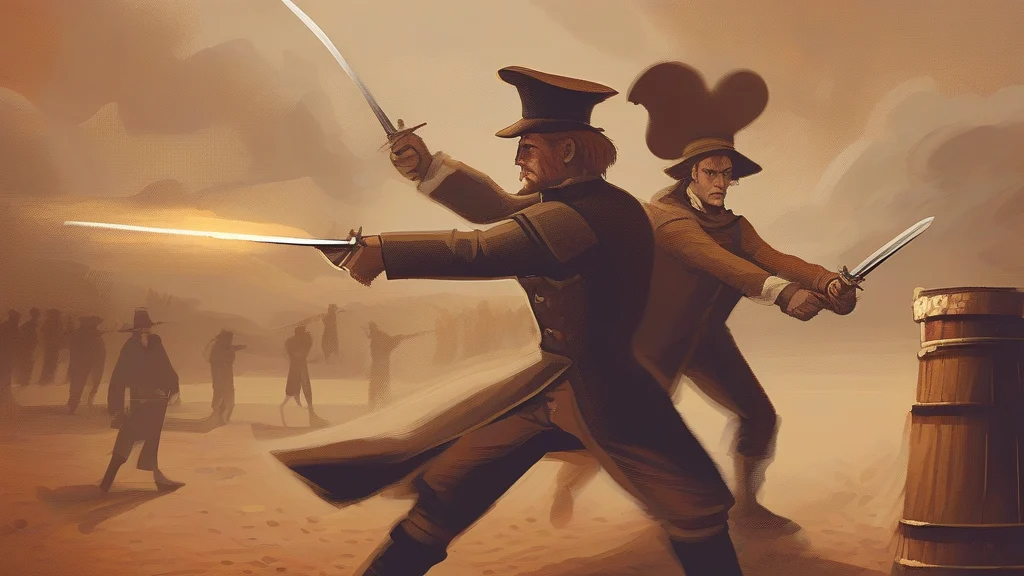
What does dueller mean?
A dueller is a person who participates in a duel — a pre-arranged, formal combat between two people, traditionally fought with swords or pistols to settle a point of honour. The word is chiefly used in historical contexts describing the practice common among European aristocracy and military officers from roughly the sixteenth to the nineteenth centuries, when codes of honour dictated that insults to reputation be answered on the field rather than in court. A skilled dueller was often admired for composure, marksmanship, and courage, though duelling itself was frequently outlawed and increasingly condemned as barbaric. In modern usage the noun can also appear figuratively, describing anyone who excels at direct one-on-one confrontation, whether in debate, chess, or sport. The spelling 'dueller', with a doubled consonant, is standard in British English, while American English generally prefers 'dueler'; the variant 'duelist' (or 'duellist') remains the more frequent word overall in everyday writing about the practice.
nounA person who fights a duel, a formal combat between two individuals using weapons. The term is the British spelling of the same word written 'dueler' in American English.
- A person who engages in or is skilled in fighting duels.
- By extension, someone habitually inclined to confront others in one-on-one contests, literal or figurative.
"The dueller calmly took his position at dawn as his seconds measured the paces between them."
"The young officer earned a reputation as the finest dueller in the regiment."
"In the final round, the veteran debuffer proved herself a formidable dueller on the chessboard."
Regular plural formed by adding -s; the British spelling doubles the consonant, while American usage writes 'duelers'.
"At dawn, the two duellers took their positions while their surgeons waited nearby."
A single letter separates the British dueller from the American duelist — but both once risked their lives over matters of honour.
Reviewed by Deb Chak, Editor. AI-assisted content curated by RJS Tech Solutions LLP.
Etymology of dueller
Dueller derives from 'duel', which entered English in the late fifteenth or early sixteenth century from medieval Latin 'duellum', a learned revival of an archaic Latin word for war that was reinterpreted as coming from 'duo', meaning two — hence a fight between two persons. The agent suffix '-er' was added to denote one who performs the action, following standard English patterns of noun formation. Cognate forms appear across European languages, all ultimately tied to the Latin root for 'two', which also gives us words like 'dual', 'duet', and 'duplicity'.
Related word forms
How dueller is actually used
British spelling uses double 'l' (dueller); American English typically writes 'dueler'. The word carries historical and somewhat formal connotations, evoking the era of formal duelling in Europe.
Easily confused with dueller
'Duelist' is simply the American spelling of the same noun — both refer to a person who duels; 'dueller' reflects British doubling of the consonant.