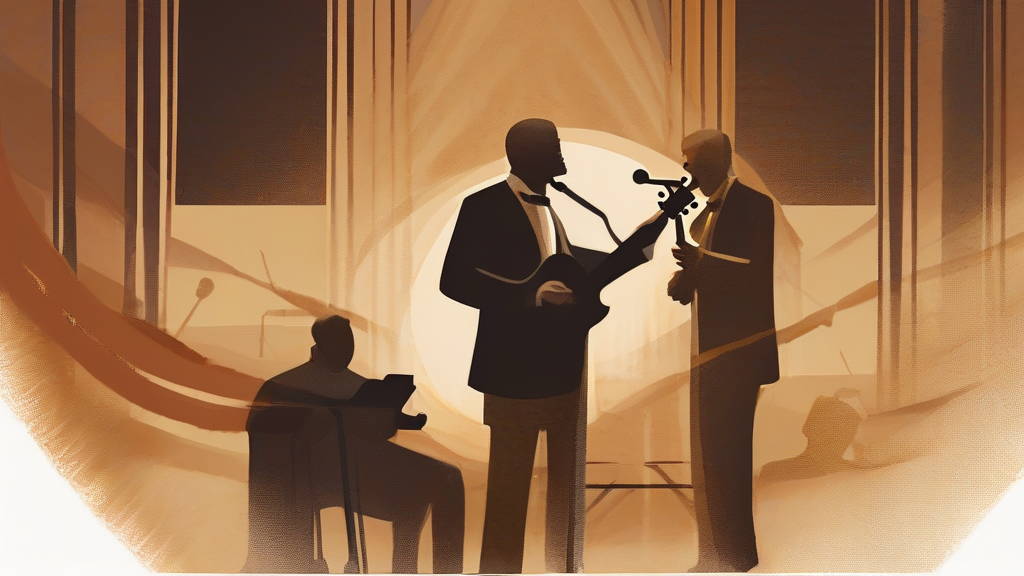
What does dueting mean?
Dueting is the present participle and gerund of the verb 'duet', meaning to perform music — whether singing or playing an instrument — as part of a pair rather than alone. The word carries connotations of partnership, harmony, and mutual artistry: when two voices blend in a ballad or two pianists share a keyboard, they are dueting. Beyond its literal musical sense, it can be used figuratively to describe two people acting in close coordination, as when politicians or business leaders appear together presenting a united front. Spelling varies by region: British English typically doubles the t ('duetting'), while American English often uses a single t ('dueting'). The word derives ultimately from the Italian 'duetto', itself rooted in the Latin 'duo', meaning 'two', making it part of a family that includes 'duo', 'dual', and 'duologue'. Though not among the most common verbs in English, it appears regularly in reviews, concert reports, and entertainment journalism.
To perform a musical work as one of a pair of singers or instrumentalists.
"They were dueting on a classic jazz standard when the power went out."
Often followed by 'with' to indicate the partner: 'dueting with a renowned cellist.'
To collaborate or act in close coordination with another person, especially publicly.
"The two anchors spent the broadcast dueting through every major headline."
Whether you write 'dueting' or 'duetting' depends largely on which side of the Atlantic you learned your spelling — both are correct.
Reviewed by Deb Chak, Editor. AI-assisted content curated by RJS Tech Solutions LLP.
Etymology of dueting
Dueting comes from 'duet', which English borrowed from the Italian 'duetto', a diminutive of 'duo' meaning 'two'. The Italian term traces back to Latin 'duo', the ancient Indo-European word for the number two. As English adopted the noun 'duet' for a performance by two musicians, it naturally formed a verb, giving rise to participles 'dueting' (American) and 'duetting' (British). Its cognates include other words built on the same root of twoness, such as 'duo', 'dual', and 'duologue'.
Related word forms
How dueting is actually used
'Duet' is used as a verb relatively informally; in formal writing about music, writers often prefer constructions such as 'performed a duet'. The spelling 'duetting' is preferred in British English, while American English commonly drops one t.
Easily confused with dueting
'Duetting' (with double t) is the standard British spelling, while 'dueting' (single t) is the more common American spelling — both mean the same thing.