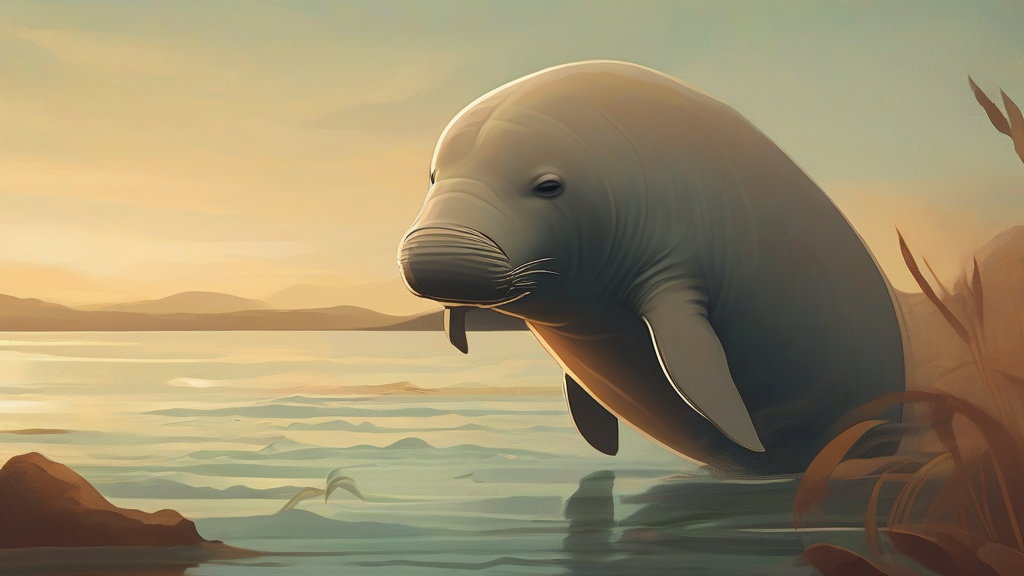
What does dugong mean?
A dugong is a large marine mammal that lives in the warm, shallow coastal waters of the Indian Ocean and the western Pacific, from East Africa and the Red Sea to Australia. It belongs to the order Sirenia, making it a close relative of the manatee, though it can be distinguished by its dolphin-like fluked tail. Dugongs are the only strictly marine herbivorous mammals, grazing for hours each day on seagrass meadows, which has earned them the nickname 'sea cow'. They can grow to around three metres in length and live for decades. The word entered English in the late seventeenth century, adapted from Malay duyung, and the creature itself is thought by some scholars to have inspired ancient tales of mermaids. Because dugongs depend on fragile seagrass habitats, they have become an emblem of ocean conservation, and the word appears most often today in scientific, environmental, and journalistic writing.
nounA large herbivorous marine mammal of warm coastal waters of the Indian and western Pacific Oceans, related to the manatee and feeding on seagrass.
- The marine mammal Dugong dugon, a large herbivorous sirenian inhabiting warm coastal waters of the Indian Ocean and western Pacific, feeding primarily on seagrass.
"The dugong grazed on the seagrass meadow just beyond the reef, surfacing briefly to breathe."
"Fishermen reported seeing a dugong grazing in the shallow bay at dawn."
"Australia's Great Barrier Reef supports one of the world's largest remaining dugong populations."
The regular plural 'dugongs' is standard; the unchanged singular form also functions collectively when speaking of the species as a group.
"Dugongs once ranged across vast stretches of the Indo-Pacific coastline."
The dugong is believed to be the origin of ancient mermaid legends — sailors who glimpsed these gentle sea cows sometimes mistook them for half-human women.
Reviewed by Deb Chak, Editor. AI-assisted content curated by RJS Tech Solutions LLP.
Etymology of dugong
The word 'dugong' entered English in the seventeenth century, borrowed from Malay 'duyung', the name used for the animal in maritime Southeast Asia. European sailors and naturalists encountered the creature during voyages through the region and adopted the local term into their own languages. The Malay word itself may ultimately relate to Proto-Austronesian roots referring to sea creatures, though this deeper origin is uncertain.
How dugong is actually used
A formal or scientific term, common in marine biology, wildlife journalism, and environmental writing rather than everyday conversation. The word takes standard plural 'dugongs', though the bare form is also used collectively.
Easily confused with dugong
Manatees are similar sirenians found mainly in the Atlantic and Caribbean with rounded paddle-shaped tails, while dugongs live in the Indo-Pacific and have fluked, dolphin-like tails.