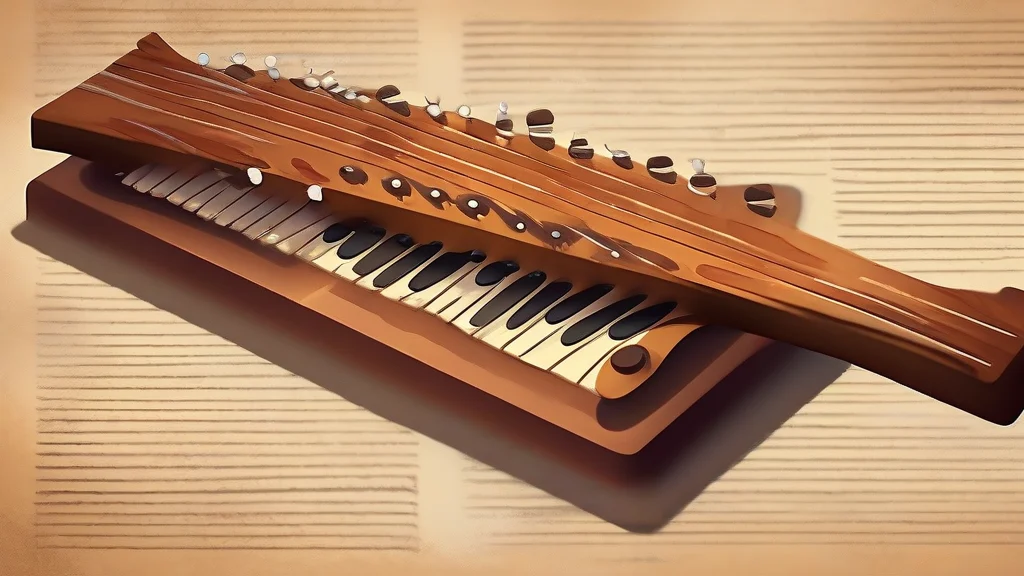
What does dulcimer mean?
A dulcimer is a stringed musical instrument, and the name covers two distinct instruments that share little beyond their sweet-sounding title. The hammered dulcimer is a trapezoidal soundboard over which many strings are stretched and struck with small hand-held hammers, producing a ringing, harp-like tone; versions of it appear across Europe, the Middle East, and Asia under names such as the santur and cimbalom. The Appalachian or mountain dulcimer is quite different: a slender, fretted American folk instrument, usually with three or four strings, that rests on the player's lap and is strummed or plucked. The word entered English from French and ultimately combines Latin 'dulcis' (sweet) with Greek-derived 'melos' (song), so it literally means 'sweet melody'. Because the bare term is genuinely ambiguous between the two instruments, careful writers specify 'hammered' or 'mountain'. Dulcimers feature prominently in folk, traditional, and early music, lending the word a rustic, old-world charm.
nounA stringed musical instrument whose strings are stretched over a trapezoidal soundboard and struck with small handheld hammers; the term also refers to a related fretted, plucked folk instrument of the Appalachian region, more fully called the mountain or Appalachian dulcimer.
- A hammered dulcimer: a trapezoidal stringed instrument played with light hammers, found across Europe, the Middle East, and Asia in many variants.
- A mountain (or Appalachian) dulcimer: a fretted, plucked American folk instrument typically held on the lap.
"She accompanied the ballad on a hammered dulcimer, its bright tones ringing through the hall."
"The hammered dulcimer's shimmering chords filled the tavern as the dancers took the floor."
"In the Appalachian tradition, players often lay the dulcimer flat on their laps and strum it with a quill or a feather."
Standard regular plural; used when referring to multiple instruments of either the hammered or the mountain type.
"The workshop displayed dozens of handcrafted dulcimers, each with a distinctive soundboard design."
The word 'dulcimer' literally means 'sweet song' — it was built from Latin 'dulcis' (sweet) and Greek 'melos' (song) long before it named any actual instrument.
Reviewed by Deb Chak, Editor. AI-assisted content curated by RJS Tech Solutions LLP.
Etymology of dulcimer
English borrowed 'dulcimer' from Old French 'doulcemelle', attested in English by the late Middle Ages to early modern period, with the spelling gradually regularized to its modern form. The French word itself derives from Latin 'dulcis', meaning 'sweet', combined with Greek 'melos', meaning 'song' or 'melody', so the name literally means 'sweet song'. The same Latin root gives English cognates such as 'dulcet' and 'dulcify', while 'melos' underlies words like 'melody'.
How dulcimer is actually used
When unqualified, 'dulcimer' most often refers to the hammered type in British usage and can refer to either type in American usage, so writers frequently specify 'hammered' or 'mountain/Appalachian' to avoid ambiguity. The word carries a folksy, old-world connotation and appears mostly in discussions of traditional, folk, and early music rather than everyday speech.
Easily confused with dulcimer
A zither is a family of plucked or bowed string instruments with strings running the full length of the body, while a dulcimer is either struck with hammers or is the specific fretted Appalachian folk instrument.
Dulcet is an adjective meaning sweet and soothing (especially of sound), whereas dulcimer is a noun naming a musical instrument.