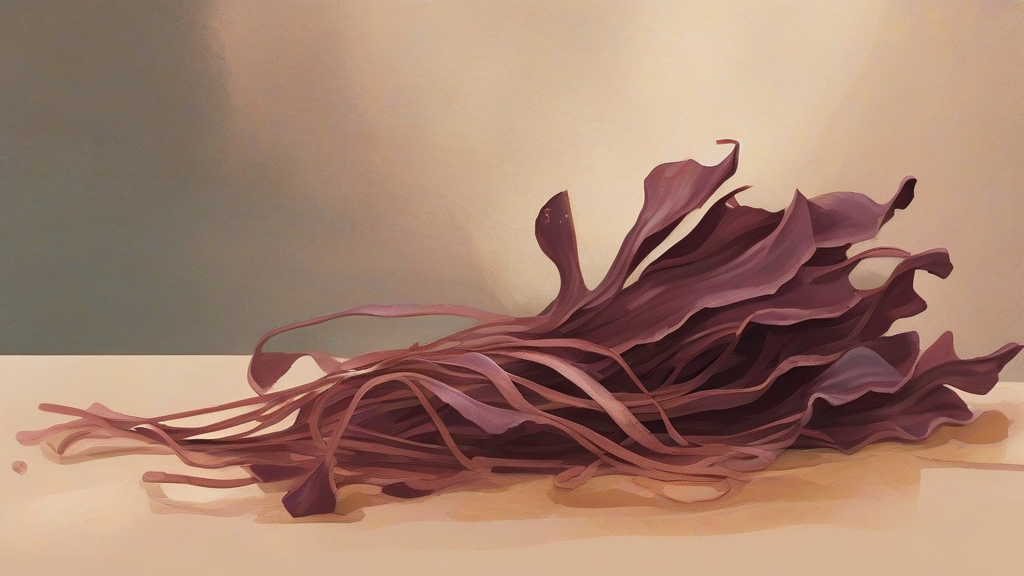
What does dulse mean?
Dulse is an edible red seaweed, known scientifically as Palmaria palmata, that grows attached to rocks along the coasts of the North Atlantic. Its flat, leathery fronds range from deep reddish-purple to brownish-red, and it has been gathered by hand for centuries in Ireland, Scotland, Iceland, and Atlantic Canada. Traditionally sun-dried and eaten straight as a chewy snack, dulse is today also sold in flakes or powder and used to season soups, salads, breads, and seafood dishes, lending a salty, smoky, umami-rich note. The word itself is regional rather than universal: it is well understood in coastal communities where harvesting remains part of local life, though many inland English speakers have never encountered it, and broader writing about sea vegetables tends to use the generic term "seaweed." Nutritionally, dulse is valued for its protein content and abundance of minerals such as iodine and potassium. As interest in foraged and sustainable foods grows, the word has appeared more frequently in cookbooks and food media, giving it a quietly fashionable edge alongside its old-fashioned maritime roots.
nounAn edible red seaweed (Palmaria palmata) that grows on rocky coasts of the North Atlantic and is eaten dried as a snack or used to flavour soups and salads.
- An edible red alga (Palmaria palmata) with flat, leathery reddish-purple fronds, harvested in the North Atlantic and eaten fresh, dried, or powdered.
"She sprinkled crumbled dulse over the potato soup for a savoury, mineral-rich depth."
"Fishermen on the coast of Nova Scotia have long harvested dulse by hand at low tide."
"The chef folded toasted dulse into the butter that dressed the scallops."
Rarely pluralized; usually treated as an uncountable mass noun referring to the seaweed generally.
"Different dulses washed up along the tideline after the storm."
In Ireland and Atlantic Canada this crimson seaweed has been chewed straight from the shore for centuries — it was even harvested by monks in medieval times.
Reviewed by Deb Chak, Editor. AI-assisted content curated by RJS Tech Solutions LLP.
Etymology of dulse
The word dulse entered English from Middle English, borrowed through Scots dialects from a Gaelic source, most likely Old Irish duilesc or its Scottish Gaelic relative duileasg, both naming the same seaweed. It has been recorded in English since at least the early 17th century, reflecting long-standing contact between coastal Britain's Gaelic-speaking harvesters and English speakers. Because the term descends from Celtic rather than Latin or Greek roots, it has few widely recognised cognates in standard English vocabulary.
How dulse is actually used
Dulse is a somewhat regional word, familiar chiefly in coastal communities of Ireland, Scotland, Atlantic Canada, and New England where the seaweed is actually harvested. It carries no negative connotation but may be unfamiliar inland; in wider contexts, speakers often reach for the generic "seaweed" instead.
Easily confused with dulse
"Pulse" refers either to a heartbeat rhythm or an edible seed such as lentils, while "dulse" is a type of edible seaweed.
Kelp is a brown seaweed, whereas dulse is a red alga; the two are sometimes confused because both are sold as edible sea vegetables.