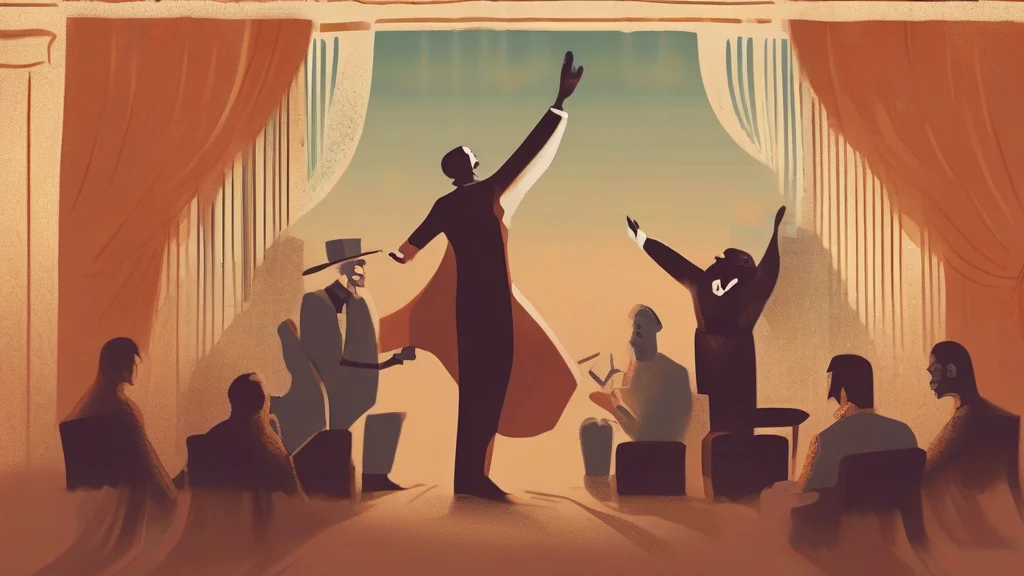
What does dumbshow mean?
Dumbshow is a form of dramatic expression in which a story or action is conveyed entirely through gesture, facial expression, and bodily movement, without any spoken dialogue. The term is closely associated with English Renaissance drama: in Shakespeare's Hamlet, a troupe of players performs a dumbshow depicting the murder of the old king, allowing the audience to anticipate the guilt that Claudius will later betray during the spoken play. Beyond its theatrical sense, dumbshow can describe any situation in which people communicate silently through physical signs — a pointed glance, a dismissive wave, a conspiratorial nod. The 'dumb' in the word preserves its older meaning of mute rather than stupid, so it carries no derogatory force. Somewhat literary in register, dumbshow remains useful for evoking both formal mime and the unspoken choreography of human interaction.
nounA theatrical performance or dramatic action conveyed entirely through gestures and facial expressions, without spoken words; a pantomime.
- A mimed performance or scene presented without speech, especially as part of a larger play
- Any communication or action expressed purely by gesture rather than words
"The play opened with a brief dumbshow in which the king was poisoned as he slept in his garden."
"In Hamlet, the traveling players stage a dumbshow reenacting King Hamlet's murder before Claudius reacts to the spoken version."
"The negotiations collapsed into a tense dumbshow of shrugs and raised eyebrows across the conference table."
The plural follows standard English formation and is used when referring to multiple mimed performances or sequences.
"Elizabethan audiences were accustomed to opening their entertainments with elaborate dumbshows."
Shakespeare smuggled an entire murder into Hamlet through a dumbshow — proof that silence can be more damning than any soliloquy.
Reviewed by Deb Chak, Editor. AI-assisted content curated by RJS Tech Solutions LLP.
Etymology of dumbshow
Dumbshow combines 'dumb,' from Old English 'dumb' meaning mute or unable to speak (ultimately from Proto-Germanic roots shared with German 'dumm'), with 'show,' from Old English 'scēawian,' meaning to look at or behold. The compound arose in the sixteenth century to describe the wordless mimed scenes popular on the Elizabethan stage, and it appears in Shakespeare's Hamlet around 1600. Its Germanic roots make it cognate with words such as 'dumbfounded' and 'dumbstruck,' which preserve the same older sense of speechlessness.
How dumbshow is actually used
Dumbshow is somewhat literary and relatively rare in everyday speech, appearing most often in discussions of drama, particularly Elizabethan theater. The element 'dumb' here retains its older sense of 'mute' rather than 'stupid,' so the word carries no insulting connotation.
Easily confused with dumbshow
Dumbfound means to astonish or bewilder someone, while dumbshow refers to wordless gestural performance.
Pantomime is a broader term that can also refer to a British Christmas theatrical genre, whereas dumbshow specifically denotes a short wordless mimed sequence, often within another work.