
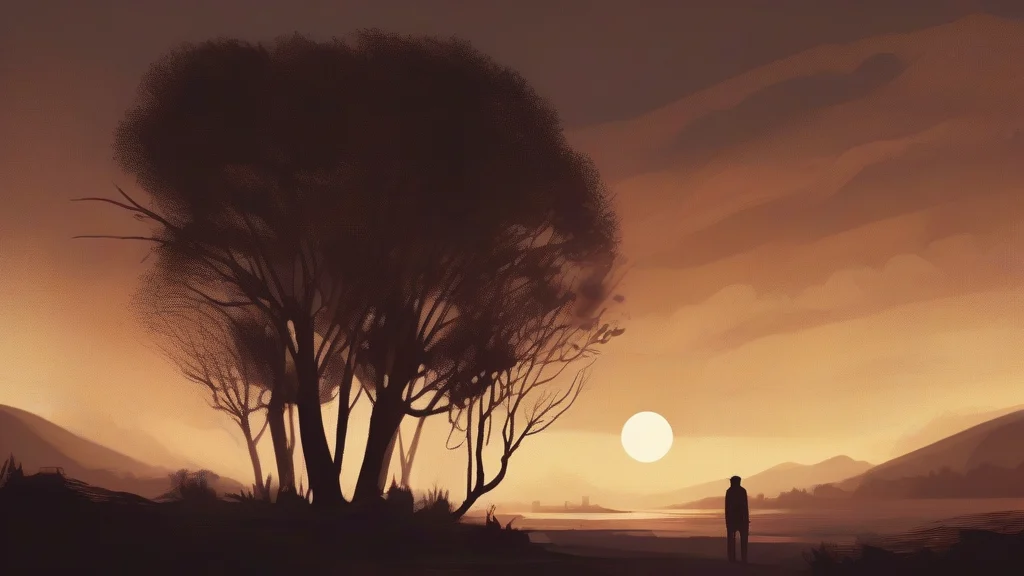
What does duskily mean?
Duskily is an adverb meaning in a dim, shadowy, or faintly illuminated way — as though lit by the soft, subdued light of dusk. It can also be used figuratively to suggest gloom, obscurity, or indistinctness of speech or expression. The word derives from 'dusky', itself formed from 'dusk' plus the suffix '-ily'. In practice, 'duskily' belongs chiefly to literary and descriptive prose: a room might be duskily lit by candlelight, figures might loom duskily at the edge of a garden, or someone might speak duskily, their words half-lost in murk or melancholy. Its connotations are atmospheric and quietly moody rather than dramatic; it suggests softness and ambiguity more than outright darkness. Because it is relatively uncommon in conversation, using it well signals careful, evocative writing. It pairs naturally with verbs of perception — glow, gleam, loom, whisper — where the dimness is part of the effect being described.
In a dim, shadowy, or faintly lighted manner; with the subdued quality characteristic of dusk.
"The lighthouse beam swept duskily across the fog-bound harbour."
Primarily literary; rare in casual conversation.
(Figuratively) Gloomily, obscurely, or in a way that is hard to make out.
"He nodded duskily and turned back toward the window."
Often applied to speech, expression, or mood.
'Duskily' is what happens when 'dusky' needs to describe not just how things look, but how things happen — the English language's way of turning twilight into an adverb.
Reviewed by Deb Chak, Editor. AI-assisted content curated by RJS Tech Solutions LLP.
Etymology of duskily
Duskily is formed from the adjective 'dusky' combined with the adverbial suffix '-ily', placing it squarely within a productive English pattern of adjective-to-adverb derivation. Its root, 'dusk', entered Middle English from Old English 'dox', meaning dark or swarthy, and is related to words in other Germanic languages describing darkness or smoke-like dimness. The word thus shares deep Germanic origins with its relatives 'dusky' and 'duskiness', all pointing back to the same ancient sense of obscured or failing light.
Related word forms
How duskily is actually used
A literary and somewhat formal word, 'duskily' appears mostly in descriptive prose and fiction rather than everyday speech. It carries a quiet, atmospheric connotation — evocative rather than merely functional — and is best suited to writing that aims for mood and imagery.
Easily confused with duskily
'Dusky' is an adjective describing something dim in color or light (a dusky sky), while 'duskily' is its adverb form describing how an action is done.