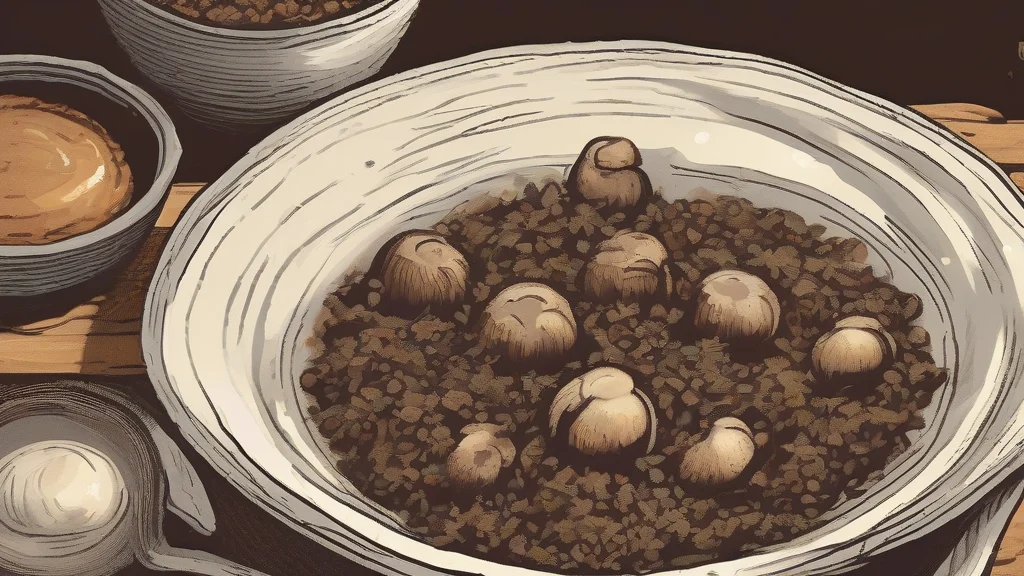
What does duxelles mean?
Duxelles is a finely chopped mixture of mushrooms, shallots or onions, and herbs that are sautéed slowly in butter until the moisture evaporates and the mixture reduces to a dark, concentrated paste. A cornerstone of classical French cuisine, it is most famously used as a layer in Beef Wellington, where it coats the beef beneath the pastry to add savoury depth and keep the crust from becoming soggy. It also serves as a stuffing for vegetables and poultry, a filling for crêpes and vol-au-vents, or a base for sauces. Because the mushrooms are so finely minced and thoroughly reduced, duxelles delivers an intense umami flavour despite its modest ingredients. Treated as a mass noun in most usage, the term appears mainly in recipes, restaurant menus, and food writing, and signals a dish prepared with traditional technique and care.
nounA finely chopped mixture of mushrooms, onions or shallots, and herbs sautéed in butter until reduced to a thick paste, used as a stuffing, garnish, or flavouring in classic French cuisine.
- A finely chopped paste of mushrooms, shallots or onions, and herbs cooked slowly in butter, used as a stuffing, filling, or garnish in French and international cuisine.
"The chef folded a spoonful of duxelles into the pastry before wrapping the beef tenderloin."
"She spread the duxelles over the crêpes before rolling them into delicate bundles."
"A well-made duxelles should be dry enough to hold its shape when pressed with a spoon."
Duxelles is most often used as an uncountable (mass) noun, like 'stuffing' or 'purée'. When a plural is needed — for example, referring to different chefs' preparations — the form remains unchanged.
"The two restaurants' duxelles differed noticeably in texture and seasoning."
Duxelles is named after the Marquis d'Uxelles — a French nobleman immortalized not by his deeds, but by his chef's mushrooms.
Reviewed by Deb Chak, Editor. AI-assisted content curated by RJS Tech Solutions LLP.
Etymology of duxelles
Duxelles comes from French, where it first appeared as duxelle in seventeenth-century cuisine. The preparation is traditionally credited to the kitchen of the Marquis d'Uxelles (Uxelles being a village in the Jura region of France), whose name was adapted into the culinary term. English borrowed the word directly from French alongside many other terms of classical French cookery.
How duxelles is actually used
Duxelles belongs to formal and professional culinary registers; it is rarely encountered in everyday speech outside cooking contexts. It is typically treated as a mass noun, though it can be pluralized. The word carries connotations of classical French technique and refined cooking.
Easily confused with duxelles
Dulse is an edible red seaweed, whereas duxelles is a cooked mushroom-and-shallot paste used in French cookery.