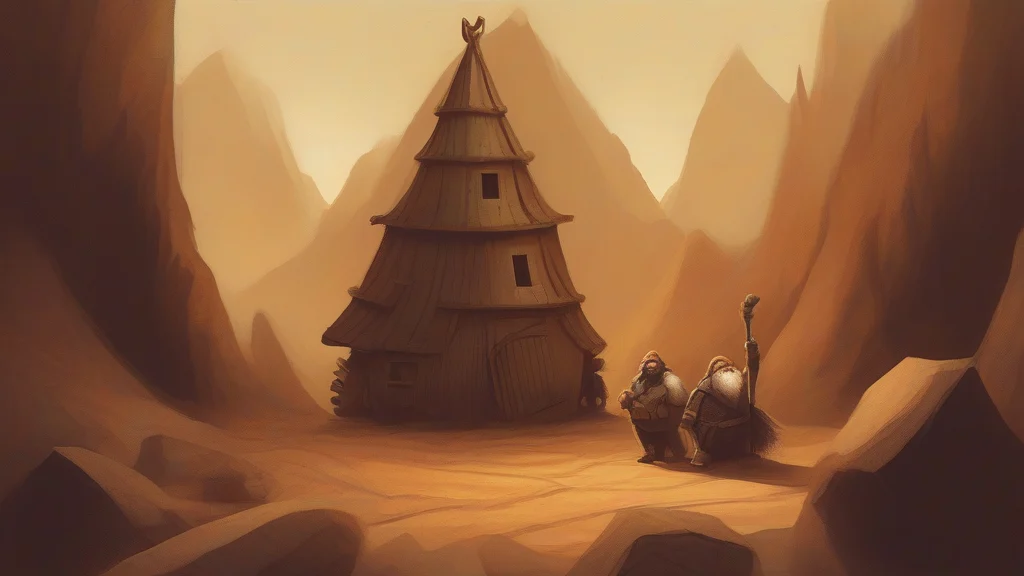
What does dwarfish mean?
Dwarfish is an adjective used to describe something that resembles a dwarf — that is, something conspicuously smaller than what is normal or expected for its kind. It applies most naturally to physical stature, but by extension it can describe any object, structure, plant, or animal of unusually reduced size: a dwarfish doorway, a dwarfish shrub, a dwarfish breed of cattle. The word derives from 'dwarf,' an Old English noun referring to a being of abnormally small human form, later extended to the mythical beings of folklore and fantasy. In tone, dwarfish is somewhat literary and descriptive; it appears more often in fiction and nature writing than in casual conversation. When referring to people with dwarfism, modern usage favours more respectful phrasing, so the word is best reserved for things rather than persons. Its usefulness lies in its precision: unlike 'tiny' or 'small,' it implies a deviation from an expected standard of size.
adjectiveResembling a dwarf in size or stature; unusually small or undersized.
- Relating to or resembling a dwarf in size; abnormally or notably small in stature or dimensions.
"The cottage had dwarfish windows and a door barely five feet high."
"A dwarfish figure shuffled out from behind the counter and peered up at us."
"The bonsai tree, though perfectly healthy, remained dwarfish compared to its wild cousins."
Before Tolkien gave us 'dwarvish' as the language of Middle-earth's dwarves, 'dwarfish' was doing all the work — describing anything amusingly undersized since the 1500s.
Reviewed by Deb Chak, Editor. AI-assisted content curated by RJS Tech Solutions LLP.
Etymology of dwarfish
Dwarfish is formed from the Old English noun 'dwarf' (dweorg) combined with the adjectival suffix '-ish.' The base word 'dwarf' has ancient Germanic roots, with cognates across Germanic languages such as Old Norse 'dvergr' and Old High German 'twerg,' and it originally denoted a human being of abnormally small stature before extending into folklore and mythology. The adjective dwarfish emerged in English during the early modern period, likely the sixteenth century, as part of the productive pattern of forming '-ish' adjectives from nouns. Cognate forms include the related derivatives 'dwarfism' (a medical term coined much later) and the fantasy-literature variant 'dwarvish.'
Related word forms
How dwarfish is actually used
Somewhat literary or descriptive in register rather than everyday speech. When applied to people, it can sound dated or potentially offensive — terms like 'having dwarfism' or 'of short stature' are generally preferred in modern usage. It remains neutral and unremarkable when applied to plants, animals, buildings, or objects.
Easily confused with dwarfish
Dwarfish means small or undersized, while dwarvish typically refers to the fictional race of dwarves in fantasy literature.