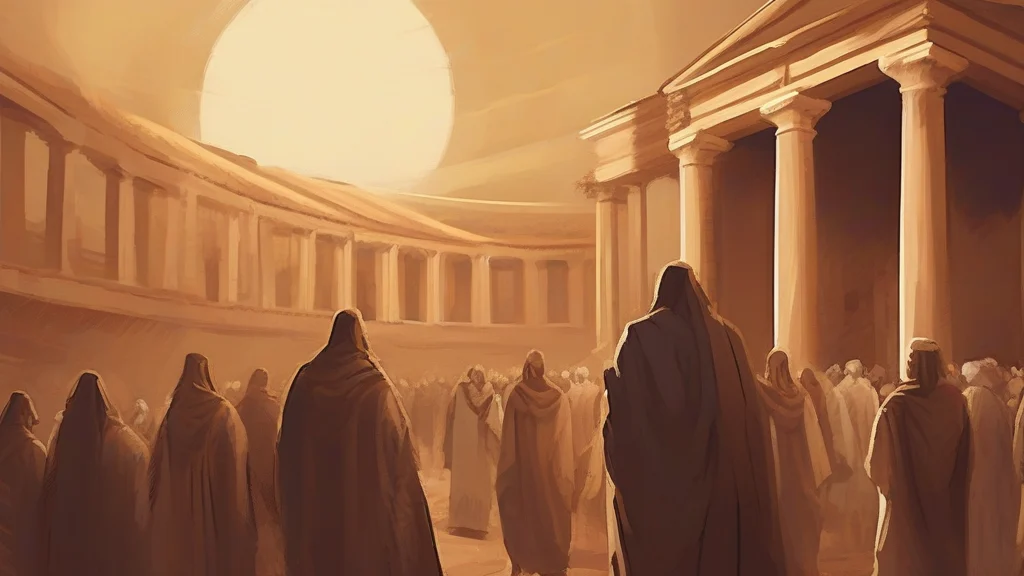
What does ecclesia mean?
Ecclesia is the Greek term for the principal assembly of citizens in an ancient Greek city-state, most famously democratic Athens, where free male citizens gathered to debate and vote on laws, war, and public policy. In this civic sense it represented the direct exercise of popular sovereignty. The word later took on a second, far-reaching life in the Greek New Testament, where ecclesia came to denote the community or body of Christian believers — which is why it underlies many modern European words for 'church', such as German Kirche and French église. Today, ecclesia appears chiefly in scholarly contexts: classicists use it for the Athenian assembly, while theologians and biblical scholars use it for the primitive church or congregation. Its register is formal and academic, and its connotations are of deliberation, community, and institutional continuity across two very different spheres — politics and religion.
nounA political assembly of citizens in an ancient Greek city-state; in the New Testament, the Christian church or congregation as a body of believers.
- The principal political assembly of citizens in ancient Greek city-states, especially Athens, where laws and decrees were debated and passed.
- The Christian church or congregation as a collective body of believers, particularly in New Testament usage.
"In classical Athens, every male citizen had the right to speak in the ecclesia."
"Pericles addressed the ecclesia to persuade the Athenians to fund the building programme that would produce the Parthenon."
"The epistles frequently refer to the local ecclesia as the gathered body of believers rather than a physical building."
The Latinized plural 'ecclesiae' is preferred in classical scholarship; 'ecclesias' is acceptable in more general English prose.
"Several independent ecclesiae met in private homes across the Roman Empire."
Every time you hear the word 'church' in a New Testament translation, the Greek original was almost always 'ecclesia' — a word that originally meant a political town meeting of citizens, not a religious gathering.
Reviewed by Deb Chak, Editor. AI-assisted content curated by RJS Tech Solutions LLP.
Etymology of ecclesia
Ecclesia derives from the Ancient Greek ekklēsia (ἐκκλησία), meaning 'assembly' or 'gathering', formed from ekkalein ('to call out'), from ek- ('out') plus kalein ('to call'). It entered English in the early modern period through Latin ecclesia and was used in both classical and biblical senses. Cognates include ecclesiastic, ecclesiastical, and ecclesiology, all sharing the same Greek root.
Related word forms
How ecclesia is actually used
Ecclesia is a scholarly or historical term, rarely used in everyday conversation. It appears mainly in academic writing on classics, theology, or biblical studies. The plural is ecclesiae (Latinized) or occasionally ecclesias.
Easily confused with ecclesia
This is a common misspelling of ecclesia, not a separate word.