What does echidna mean?
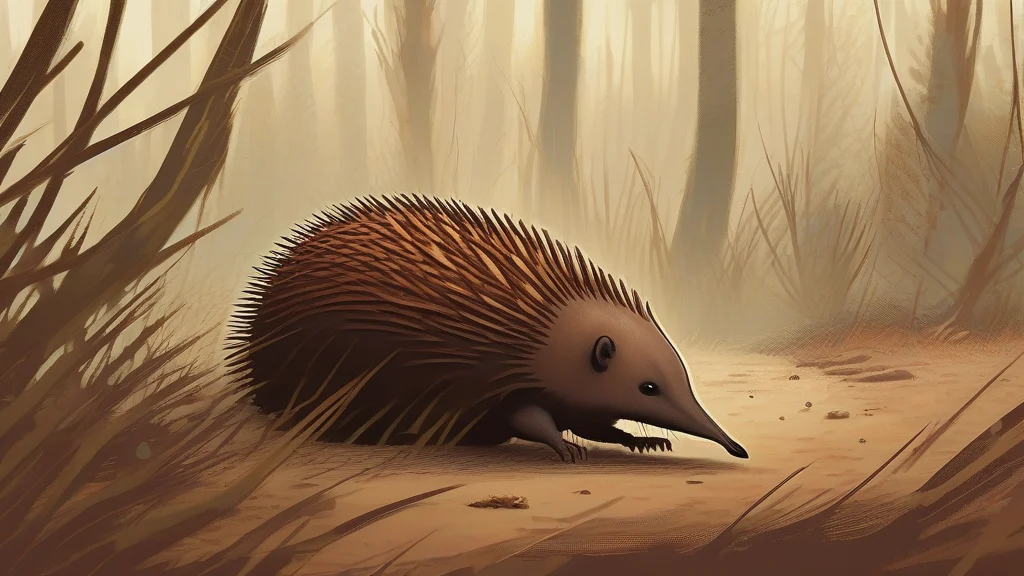
An echidna is a distinctive egg-laying mammal found in Australia and New Guinea, instantly recognizable by the coat of sharp spines covering its back. Along with the platypus, it belongs to the monotremes, the only mammals that reproduce by laying eggs rather than giving birth to live young. Echidnas use their long, slender snouts and sticky tongues to feed mainly on ants and termites, and when threatened they dig quickly or curl into a protective ball of spines. The best-known species are the short-beaked echidna of Australia and the long-beaked echidnas of New Guinea. The word also names a fearsome half-woman, half-serpent monster of Greek mythology, mother to legendary creatures such as Cerberus and the Hydra. Whether encountered in nature documentaries or classical myths, echidna carries connotations of ancient lineage, oddity, and resilience.
A small egg-laying mammal of Australia and New Guinea, covered in spines, with a long snout and sticky tongue adapted for eating ants and termites.
"The echidna burrowed into the soil until only its spines were visible."
In Greek mythology, a monstrous half-woman, half-serpent creature regarded as the mother of many famous monsters.
"Greek poets described Echidna as a fearsome hybrid dwelling deep beneath the earth."
Usually capitalized when referring to the mythological figure.
Regular plural formation by adding -s; used for both the animals collectively and multiple instances in reference.
"Long-beaked echidnas are now confined to the highland forests of New Guinea."
The echidna lays eggs yet nurses its young on milk — one of only five mammal species on Earth that can do both, alongside its cousin the platypus.
Reviewed by Deb Chak, Editor. AI-assisted content curated by RJS Tech Solutions LLP.
Etymology of echidna
The word echidna derives from ancient Greek Echidna, the name of the serpent-woman of mythology, which itself comes from Greek echis, meaning 'viper' or 'snake'. The zoologist George Shaw applied the name to the Australian mammal when he described it in the late eighteenth century, presumably alluding to the creature's snake-like snout or tongue. The same Greek root also gives us the adjective echidnine relating to these animals.
Related word forms
How echidna is actually used
When capitalized and referring to the mythological creature, it is usually treated as a proper noun. The animal sense is most common in Australian English and scientific writing about wildlife.
Easily confused with echidna
A porcupine is a rodent whose quills detach easily, whereas an echidna is an egg-laying monotreme whose spines are firmly rooted in its fur.