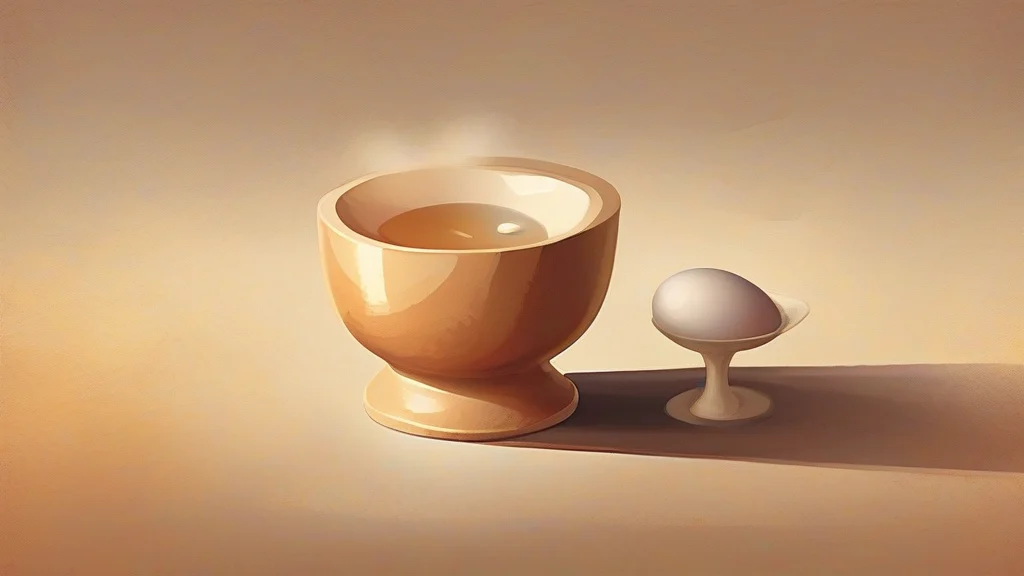
What does eggcup mean?
An eggcup is a small cup, usually made of ceramic or porcelain and often fitted with a short stem or foot, designed to hold a boiled egg upright so that it can be eaten directly from the shell. The diner taps away the top of the shell and scoops out the contents with a small spoon. Eggcups are a fixture of the traditional soft-boiled-egg breakfast, particularly in Britain, where the ritual of dipping toast soldiers into a runny yolk is closely tied to them. The word appears as a closed compound "eggcup" in British English and frequently as "egg cup" elsewhere. Though humble, eggcups have long been decorative objects: antique sets of painted china eggcups are collected, and novelty designs shaped like animals or figures were popular throughout the twentieth century. In modern usage the word evokes domestic comfort, childhood breakfasts, and a slightly old-fashioned charm.
nounA small cup, often with a footed base, used for holding a boiled egg while it is eaten from the shell.
- A small cup, typically footed, used to hold a boiled egg while it is eaten from the shell.
"She set a soft-boiled egg in its eggcup and handed it to him with a small spoon."
"He tapped his spoon sharply against the shell of the egg resting in its eggcup."
"The breakfast table was laid with linen napkins, silver spoons, and matching porcelain eggcups."
The plural follows regular noun inflection; the closed spelling "eggcups" predominates in British English, while "egg cups" is more frequent in American usage.
"She inherited a dozen delicate Limoges eggcups from her grandmother."
Before the eggcup arrived on European tables in the 17th century, boiled eggs were balanced in whatever came to hand — the little china cup turned breakfast into an occasion.
Reviewed by Deb Chak, Editor. AI-assisted content curated by RJS Tech Solutions LLP.
Etymology of eggcup
Eggcup is a straightforward English compound formed from "egg" and "cup," combining two native Old English words: ægg (egg) and cuppe (cup), both well established by the Middle Ages. The compound itself emerged in English usage around the seventeenth century, when boiled eggs served in the shell became a fashionable breakfast item in Europe. It shares its elements with countless other household compounds such as teacup and eggshell, reflecting the productive pattern of English noun-plus-noun compounding.
How eggcup is actually used
"Eggcup" is the standard closed spelling in British English; American English more often writes it as the two-word "egg cup," though the closed form is understood everywhere. The word belongs chiefly to domestic, everyday vocabulary and carries a cozy, traditional connotation — eggcups are associated with classic soft-boiled-egg breakfasts and are common in vintage or heirloom tableware collections.
Easily confused with eggcup
The two-word form 'egg cup' is simply an open compound describing any cup used for an egg, whereas 'eggcup' is the closed compound form; both refer to the same object and are largely interchangeable.