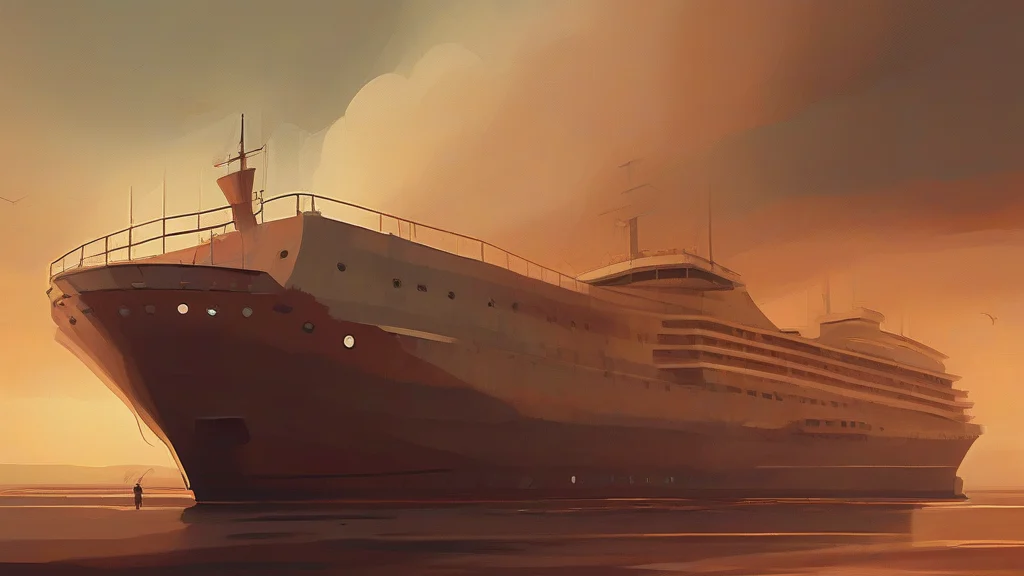
What does embarcation mean?
Embarcation refers to the act of going on board a ship, aircraft, or similar vehicle at the start of a journey. It functions as a noun and belongs to a formal register, appearing most often in maritime, military, and official travel contexts — for example, 'the port of embarcation' or 'the troops' embarcation was completed by nightfall'. The word is best understood as a less common variant spelling of 'embarkation', which dominates modern usage; writers today almost always choose the latter form. Both derive ultimately from the Late Latin 'barca', a small ship, via the verb 'embark'. Because of its rarity, 'embarcation' can lend historical flavour to prose about voyages, though readers unfamiliar with it may perceive it as a misspelling. Its natural opposites are disembarkation and arrival, marking the end of a passage rather than its beginning.
nounThe act of going on board a ship, aircraft, or other vehicle for departure. A rarer variant of the more common word 'embarkation'.
- The act of boarding a ship, aircraft, or other conveyance in preparation for departure.
"The passengers' embarcation was delayed by heavy fog in the harbour."
"Embarcation of the troops began at dawn and continued through the night."
"Travellers gathered at the point of embarcation, passports in hand, awaiting the ferry."
The plural is rare, typically used when referring to multiple separate acts of boarding or multiple points of departure.
"The port handled thousands of embarcations each year during the height of transatlantic travel."
Before you call it 'embarkation', know that sailors once said 'embarcation' — a spelling that drifted from Spanish 'embarcación' before English settled on its own.
Reviewed by Deb Chak, Editor. AI-assisted content curated by RJS Tech Solutions LLP.
Etymology of embarcation
Embarcation entered English in the early modern period, borrowed through French from Spanish 'embarcación', which derives from the verb 'embarcar' — literally 'to put into a boat'. At its root lies the Late Latin 'barca', a term for a small vessel, which also gave English the words 'barque' and 'barge'. The variant spelling 'embarkation', built on the verb 'embark', eventually became the dominant form in English.
How embarcation is actually used
'Embarcation' is considerably less common than 'embarkation', which is the preferred spelling in contemporary usage; it appears chiefly in older texts, legal documents, or travel writing that preserves traditional phrasing such as 'port of embarcation'. The word carries a formal, somewhat nautical register rather than everyday conversational tone.
Easily confused with embarcation
'Embarkation' is the standard modern spelling of the word meaning boarding a ship or aircraft; 'embarcation' is an older or less common variant spelling of the same word.
Despite sharing the prefix 'emb-', 'embarrassment' means discomfort or self-consciousness and has no connection to boarding a vessel.